
Most people who search for private portfolio management assume it means a bigger version of a standard PMS account. It usually means something more specific: a mandate document negotiated line by line, where exclusions, position limits and benchmarks are set for one client rather than applied from a published model strategy.
Understanding this distinction before you sign anything changes the questions you ask a prospective manager, and often changes which manager you choose.
Key Takeaways
A bespoke mandate is defined by what it excludes and limits, not just what it invests in.
Benchmark choice is negotiable, and a poorly chosen benchmark can make an average manager look skilled or a good one look mediocre.
Ask to see the actual mandate wording, not a summary, before agreeing to any private portfolio arrangement.
What Makes a Mandate 'Bespoke' Rather Than Standard
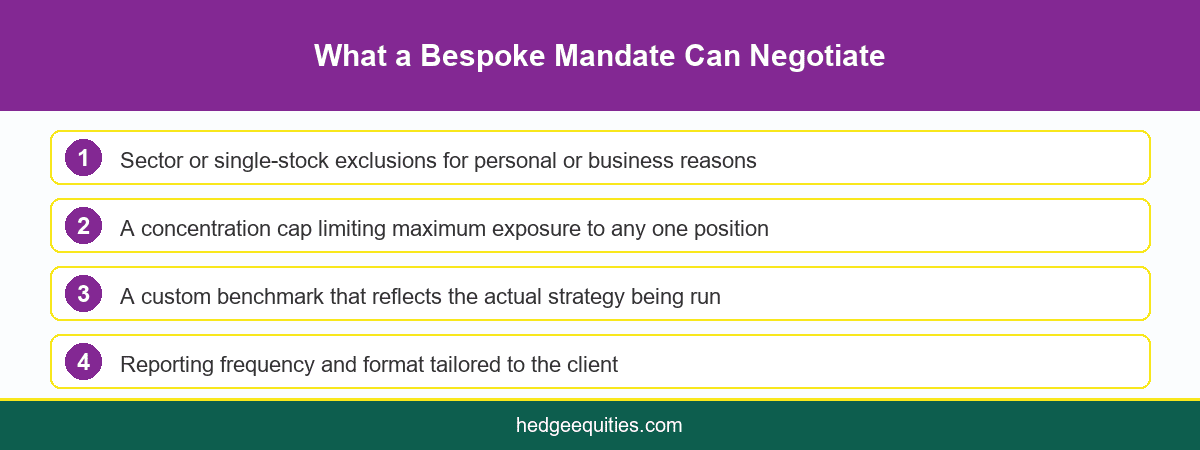
A standard PMS strategy is published once and applied to every client who chooses it: the same stock universe, the same rebalancing rules, the same benchmark. A bespoke mandate starts from that same base strategy but is then modified in writing for one client's specific requirements, whether that is excluding a sector, capping single-stock exposure, or building around an existing concentrated holding the client already carries.
This distinction is not cosmetic. Two clients with identical portfolio values can receive materially different management if one has a standard strategy applied and the other has negotiated a mandate around their specific constraints.
The practical test is simple: ask the provider to show you exactly which clause in your agreement differs from their standard published strategy document. If the answer is 'none, but we can manage it a bit differently in practice,' that is an informal accommodation, not a bespoke mandate, and informal accommodations are the first thing to disappear when a relationship manager changes or the firm grows.
Exclusions: What You Can Ask a Manager to Avoid
Common exclusions include sectors a client wants no exposure to for personal, religious or reputational reasons, direct competitors of a family business, or asset classes the client considers too volatile for their situation. A credible provider will document these exclusions in the mandate itself, not just note them informally.
Exclusions should also be reviewed periodically rather than set once and forgotten. A family business that exits a particular industry, or an investor whose personal circumstances change, may want to revisit an exclusion list every year or two as part of the normal mandate review cycle.
Concentration Caps: Protecting Against a Single Bad Bet
A concentration cap limits how much of the portfolio can sit in any single stock or sector at one time, regardless of how convinced the manager is about that position. For a client who already carries concentration risk through a family business or ESOP holding, this cap should account for that existing exposure, not just the managed portfolio in isolation. Cluster 4.6 on concentrated single-stock and family-business risk goes deeper into this specific situation.
A well-written concentration cap also specifies what happens when a position grows past the limit through market appreciation rather than a new purchase. Does the manager trim automatically, or only on the client's instruction? This operational detail is easy to overlook during negotiation and matters a great deal the first time a single holding doubles in value.
Concentration caps can also be layered: a cap on any single stock, a separate and usually higher cap on any single sector, and in some mandates a cap on exposure to a single asset manager's other funds if the portfolio holds pooled vehicles alongside direct equity. A client with an existing concentrated position outside the managed portfolio, for instance in a family business, should ask the manager to account for that external exposure when setting these internal caps, not just the assets under the mandate itself.
Benchmark Choice: The Quietest Negotiation in the Mandate
Every PMS performance report compares your portfolio against a benchmark index. A generic large-cap index benchmark can make a genuinely skilled small-cap or thematic manager look average, and a narrow sector benchmark can flatter a manager who simply rode a broad market rally. A bespoke mandate lets the client and manager agree on a benchmark that actually reflects the strategy being run, and that agreement should be documented, not left to the manager's discretion after the fact.
It is reasonable to ask why a specific benchmark was chosen and what alternative benchmarks were considered. A manager who cannot explain this clearly may not have thought carefully about how their own strategy should be measured, which is itself useful information about the relationship you are entering.
How to Ask for a Bespoke Mandate
Before signing, ask the provider directly whether their standard strategy document can be modified for exclusions, concentration caps and benchmark choice, and ask to see the modified mandate wording, not a verbal assurance. The vetting process covered in our guide to choosing a PMS service provider applies here as well: a provider who resists putting these modifications in writing is not offering a true bespoke mandate, whatever they call it in conversation.
Finally, agree on a review cadence for the mandate itself, separate from routine performance reporting. An annual mandate review, where exclusions, caps and benchmark are revisited against your current circumstances, keeps the agreement relevant as your situation changes rather than freezing it at the moment you first signed.
What a Negotiation Conversation Actually Sounds Like
In practice, a mandate negotiation conversation is less dramatic than it sounds. It typically starts with the manager's standard strategy document as a baseline, followed by a client-side list of constraints: perhaps no exposure to a specific competitor, a maximum 8 percent single-stock weight instead of the standard strategy's 15 percent, and a benchmark blend of 70 percent large-cap and 30 percent mid-cap instead of a pure large-cap index.
Each of these requests should come back to the client in writing as a proposed amendment, not a verbal 'yes, we can do that.' A provider who takes two or three rounds of written back-and-forth to finalise a mandate is usually taking the process more seriously than one who agrees to everything in a single meeting and produces a document weeks later that looks identical to the standard strategy.
When a Bespoke Mandate Is Not Worth Pursuing
Bespoke mandates are not automatically the right answer for every investor who can afford one. Highly customised exclusions and caps can reduce diversification if applied too aggressively, and a manager spending more time on documentation and compliance for a heavily modified mandate has less time for the underlying research and monitoring that actually drives returns.
A reasonable middle ground for many investors is a small number of high-priority modifications, typically one or two exclusions that genuinely matter and a concentration cap that reflects real external exposure, rather than a long list of minor preferences that add complexity without meaningfully changing the risk profile of the portfolio.
Discuss this trade-off openly with your provider rather than assuming more customisation is always better. A good advisor will tell you plainly when a requested modification is unlikely to change outcomes meaningfully and is mainly adding administrative overhead, rather than agreeing to every request simply to close the sale.
Reviewing and Updating a Mandate Over Time
A mandate signed today should not be treated as permanent. Family circumstances change, a business is sold or expanded, a new dependent arrives, or an investor's own risk appetite shifts after living through a full market cycle. Building a scheduled review into the mandate from the outset, rather than waiting for a client to raise a concern, keeps the arrangement genuinely private and current rather than bespoke only on the day it was signed.
A practical cadence many Kerala-based advisory relationships use is an annual formal review alongside more frequent informal check-ins, particularly around known family events such as a business transaction, a marriage, or a significant inheritance. Each formal review should produce a written record of what changed in the mandate, if anything, so that the history of the relationship is documented rather than relying on memory years later.
Ultimately, the value of a bespoke mandate compounds over time precisely because it is revisited rather than left static. A mandate that reflected your situation accurately five years ago but has never been updated since is, in practice, drifting back toward a standard strategy, just one that started from a more customised base.
For a Kerala business family or a Gulf-NRI HNI in particular, this discipline of periodic review matters more than for a typical metro investor, precisely because the underlying situation, a family business, a cross-border income, a succession plan, tends to change in larger, less predictable steps than a salaried professional's finances usually do.
Keep your own copy of every mandate amendment alongside the original agreement, rather than relying solely on the provider's file. In a long relationship spanning a decade or more, having your own complete record makes any future review, transfer to a new advisor, or family succession event considerably smoother than reconstructing the mandate's history from memory or a provider's archive.
Conclusion
Private portfolio management earns its name through negotiation, not portfolio size alone. Exclusions, concentration caps and benchmark choice, all documented in writing, are what separate a genuinely bespoke mandate from a standard strategy with a client's name on it. Hedge Equities structures Portfolio Management Services mandates around exactly these terms for its Kerala and Gulf-NRI HNI clients.
Investments in securities market are subject to market risks. Read all the related documents carefully before investing. Hedge Equities Ltd is registered with SEBI as a Portfolio Manager (PMS-INP000003476) and a Research Analyst (RA-INH000004398). This article is for general educational purposes and does not constitute personalised investment advice.
Frequently Asked Questions
What is private portfolio management?
It is a PMS arrangement where mandate terms, such as exclusions, concentration limits and benchmark choice, are negotiated specifically for one client rather than applied from a standard published strategy.
Can I exclude specific stocks or sectors from my PMS portfolio?
Yes, if the provider offers a bespoke mandate. Ask for this in writing as part of the mandate document, not as a verbal understanding with your relationship manager.
Why does the benchmark used in a PMS report matter?
The wrong benchmark can make an average manager look skilled or a genuinely good manager look mediocre. A bespoke mandate lets you agree on a benchmark that actually fits the strategy being run.
What is a concentration cap in portfolio management?
It is a mandate rule limiting how much of the portfolio can sit in a single stock or sector, protecting against outsized losses from one bad position.
Is a bespoke mandate more expensive than standard PMS?
Not necessarily, though highly customised mandates can carry different fee terms. Always request a written fee schedule alongside any customised mandate.
How is private portfolio management different from a mutual fund?
A mutual fund pools many investors into one published strategy. Private portfolio management manages one client's portfolio individually, allowing customisation a pooled fund cannot offer.
Who typically needs a bespoke PMS mandate?
Investors with existing concentrated holdings, specific exclusion requirements, or a return profile that a standard published strategy does not fit, most often HNI and family-business investors.
What should be included in a written PMS mandate?
Exclusions, concentration caps, benchmark choice, fee structure and reporting frequency should all appear in writing in the mandate document, not left to verbal understanding.
How do I verify my PMS provider will honour a bespoke mandate?
Review the SEBI-mandated Disclosure Document and the signed mandate agreement together. See our full vetting checklist for PMS providers for the complete process.
Does a bespoke mandate guarantee better returns?
No. SEBI rules prohibit return guarantees. A bespoke mandate improves fit with your constraints and goals, not the certainty of outperformance.