
The face of the moon was in shadow
This is the oldest argument in Indian personal finance. Buy a life insurance with investment plan that does both jobs, or buy cheap term cover and invest the difference. Both camps argue with conviction and neither usually shows the arithmetic. This article sets out the structure of that comparison over twenty years so you can run it on your own numbers.
Key Takeaways
The comparison only works if both routes buy the same sum assured. Comparing a bundled plan against a smaller term plan plus investments is not a comparison at all.
The separate route usually wins on expected wealth. The bundled route can still win for an investor who would not actually sustain the investing leg, which is a behavioural question rather than a mathematical one.
Setting Up a Fair Comparison
Most published comparisons are rigged, usually unintentionally. They compare products with different sums assured, different terms or different risk profiles, and then declare a winner. Three variables must be held constant before any conclusion means anything.
Fix the sum assured first. If the bundled plan provides fifty lakh rupees of cover, the alternative must buy fifty lakh rupees of term cover, not twenty five. Fix the term next, because a fifteen year comparison and a twenty five year comparison produce different winners. Fix the annual outlay last, so both routes consume the same amount from your budget.
Only then does the structure become clear. Under the separate route, the term premium is deducted from the annual outlay and everything remaining goes into the investment. Under the bundled route, the full outlay goes to the insurer, who allocates part to cover, part to charges and the remainder to the fund.
Hold the risk profile constant as well. A comparison against a diversified equity fund and one against a conservative hybrid fund will not produce the same answer, and neither is wrong so long as the choice is stated. Decide what you would genuinely hold under the separate route before running the numbers, rather than choosing the allocation that makes your preferred conclusion come out ahead.
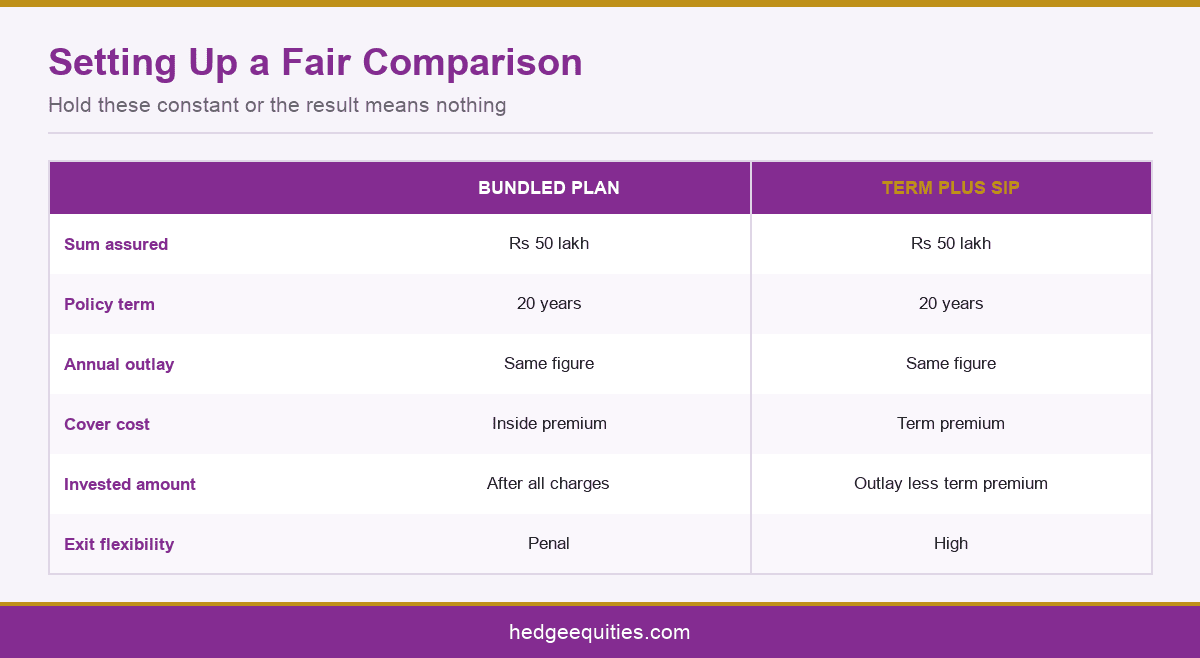
[Alt: Infographic showing how to fairly compare a life insurance with investment plan against term cover plus SIP] | File: infographic-1-fair-comparison-setup.png
Change any one of these and the winner changes with it.
Where the Money Actually Diverges
The gap between the two routes comes from three places: the cost of cover, the level of charges and the asset allocation. Understanding which of the three dominates in your case tells you which route is likely to win.
Pure term cover is remarkably cheap relative to the sum assured, because it prices mortality risk and nothing else. That leaves a large majority of the annual outlay available to invest under the separate route. Under the bundled route, allocation, administration, mortality and fund management charges are all deducted before anything compounds.
Asset allocation is the second driver and often the larger one. A systematic investment plan into a diversified equity fund carries a different long term expected return from a conservative with profits fund. Over twenty years that difference compounds heavily. Fund data published by AMFI lets you check historical category returns yourself rather than relying on a brochure.
Charges also fall unevenly across the term. Premium allocation charges are typically heaviest in the early years, which is precisely when compounding has the longest runway ahead of it. Money removed in year one costs you far more by year twenty than the same amount removed in year fifteen, so a simple average of charges across the term understates the real drag.
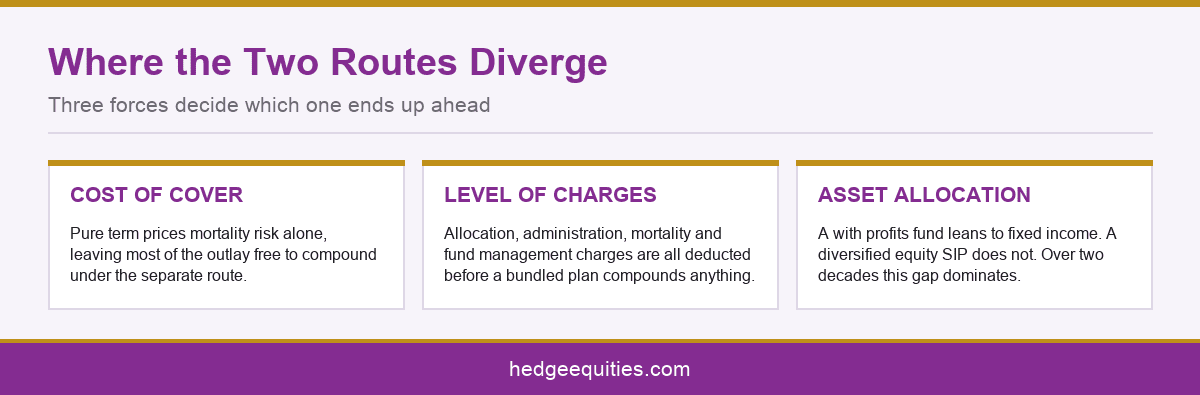
[Alt: Infographic showing the three drivers separating a ULIP from term insurance plus a SIP] | File: infographic-2-where-money-diverges.png
Over twenty years, allocation usually matters more than charges.
What Tax Does to Each Route
Tax used to be the decisive argument for bundling. Two amendments have largely removed that advantage for larger premiums, and any comparison built on the old position now reaches the wrong conclusion.
For unit linked plans issued on or after 1 February 2021, maturity proceeds lose the Section 10(10D) exemption where aggregate annual premium exceeds two and a half lakh rupees, and the gain is taxed as capital gains. For other life policies issued on or after 1 April 2023, the exemption is lost above five lakh rupees of aggregate annual premium.
Below those thresholds the bundled route retains a genuine tax edge, and for many households that is where the premium actually sits. Above them, the two routes are taxed far more similarly, and the decision reverts to cost and allocation. Confirm your own position with the Income Tax Department rather than assuming, because the test looks at aggregate premium across policies.
Deduction under Section 80C, capped at one and a half lakh rupees, applies only under the old tax regime. As more taxpayers move to the new regime, that deduction disappears from the comparison altogether. Check which regime you file under before crediting a bundled plan with a tax benefit you may not actually be claiming.
Note also that the two thresholds operate independently. Unit linked plans are tested against the two and a half lakh limit, other life policies against the five lakh limit, and each is assessed on its own aggregate. Holding both types does not merge the two tests, which is a detail worth confirming before restructuring anything.
The Argument the Maths Cannot Settle
Every calculation of this kind assumes the investor actually invests the difference every month for twenty years without interruption. A significant number do not, and for them the theoretical winner is not the practical one.
A premium notice carries social and psychological weight that a voluntary transfer does not. Missing it feels like a failure. Skipping a monthly investment feels like a postponement. That asymmetry is real, and it is the strongest honest argument for a bundled product.
The counter is that automation has narrowed the gap considerably. An auto debit mandate on a systematic investment plan removes most of the discretion that causes lapses. If you can honestly commit to that, the behavioural argument weakens sharply and the cost argument reasserts itself. Our analysis of when combining insurance and investment works examines this profile in more detail.
There is a middle path worth considering. Buy the term cover, set up the systematic investment plan with an auto debit mandate on the day your salary arrives, and treat it as non negotiable. Most of the behavioural advantage of a bundled product comes from removing the monthly decision, and automation removes it just as effectively at a fraction of the cost.
How to Decide in Your Own Case
Rather than accepting a general verdict, run the comparison on your own sum assured, term and outlay. The exercise takes under an hour and gives you a defensible answer rather than an inherited opinion.
Get a term quote for your required cover. Subtract it from your annual outlay to find the investable balance. Project that balance at a realistic return for your chosen allocation, apply the relevant tax treatment and compare against the bundled plan's illustrated maturity value net of tax. Then ask the honest behavioural question about whether you would sustain the investing leg.
If you would rather not build the model yourself, a SEBI registered firm can run it against your actual quotes. Hedge Equities does this as part of our advisory process for investors across Kerala and the Gulf.
Whatever you conclude, write down the assumptions you used. The sum assured, the term, the assumed return and the tax treatment all drive the answer, and revisiting them in five years is far easier if they are recorded. It also protects you against a future recommendation built on quietly different assumptions.
Repeat the exercise if either quote changes materially before you commit. Term premiums and illustrated values are typically valid for a limited window, and a comparison run on expired figures is no better than no comparison at all.
Conclusion
A life insurance with investment plan and the term plus investment route can both be defensible, but only one is right for your circumstances. Hold the sum assured, term and outlay constant, apply the current tax rules rather than the old ones, and be honest about whether you would sustain a voluntary investment for two decades. If you want that comparison run properly on your own figures, contact our team.
Frequently Asked Questions
Is a ULIP better than a term plan with a SIP?
Usually not on expected wealth, because charges are higher and part of the premium funds cover. It can be better for an investor who would not sustain a separate monthly investment for the full term.
How much term cover should I buy for the comparison?
Exactly the same sum assured as the bundled plan provides. Comparing a bundled plan against a smaller term plan makes the comparison meaningless and always flatters the bundled product.
Are ULIP returns tax free?
Only below the threshold. For plans issued on or after 1 February 2021, the exemption is lost where aggregate annual premium exceeds two and a half lakh rupees, and gains are then taxed as capital gains.
What charges does a ULIP carry?
Typically premium allocation, policy administration, mortality and fund management charges. Ask for the total in rupees across the full term rather than as a first year percentage.
Can I switch funds inside a ULIP?
Most unit linked plans allow switching between the funds offered, often with a number of free switches each year. You cannot move the money outside the policy without surrendering it.
What if I cannot maintain the SIP?
That is the strongest argument for a bundled plan. An auto debit mandate removes most of the discretion that causes lapses, so consider whether automation solves the problem before paying for it through charges.
Does a ULIP have a lock in period?
Yes, unit linked plans carry a mandatory lock in of five years, during which you cannot withdraw. Traditional plans have no fixed lock in but penalise early surrender heavily.
Which route is better for a twenty year goal?
Over long horizons the allocation difference dominates, which usually favours the separate route with equity exposure. Run the projection on your own figures rather than assuming either way.
Should NRIs in the Gulf approach this differently?
Currency, repatriation and residency status all affect the answer, and tax treatment can differ. Take advice specific to your jurisdiction before committing to a long term Indian policy.
Where can I get both options quoted and compared?
A registered advisory firm can obtain quotes for both routes and model them side by side. See who we serve for the investor profiles Hedge Equities works with.
Disclosure
Hedge Equities Ltd is registered with SEBI as a Portfolio Manager (INP000003476) and as a Research Analyst (INH000004398). This article is educational and does not constitute investment advice or a recommendation to buy any specific product. Investments in securities markets are subject to market risks. Read all scheme and policy documents carefully before investing. Illustrative figures are for explanation only and are not a promise of returns.