
Investment insurance sells certainty. A guaranteed maturity value, a guaranteed income, a promise that does not move with markets. That certainty is genuine and for some investors it is exactly right. It is also not free. This article prices the guarantee, so you can decide whether what you give up is worth what you receive.
Key Takeaways
A guarantee is funded by conservative investment and a margin held by the insurer. You pay for it in foregone expected return, not in a separate visible fee.
Lock ins are the second cost. Unit linked plans carry a mandatory five year lock in, and traditional policies penalise early exit heavily even without a formal one.
What You Are Actually Buying
A guarantee is a transfer of risk. The insurer agrees to bear the uncertainty that you would otherwise carry, and prices that transfer into the product. Seeing where the price sits is the first step to judging whether it is fair.
To promise a fixed sum on a fixed date, an insurer must invest conservatively enough that the promise holds in poor markets. That means heavy weighting toward government securities and high quality debt, monitored under the solvency framework administered by the Insurance Regulatory and Development Authority of India. The return on that portfolio sets the ceiling on what can be guaranteed.
The insurer then retains a margin for the risk it has assumed and its own expenses. What reaches you as a guaranteed rate is therefore below the return on the underlying assets, which is itself below what a growth portfolio might deliver over a long horizon. That difference is the price of certainty, and it does not appear as a line item anywhere.
The solvency framework is worth understanding in outline. Insurers are required to hold capital against the promises they have made, and that requirement constrains how aggressively they can invest the assets backing a guarantee. This is a feature rather than a defect. It is what makes the guarantee credible, and it is also why the guaranteed rate cannot be higher.
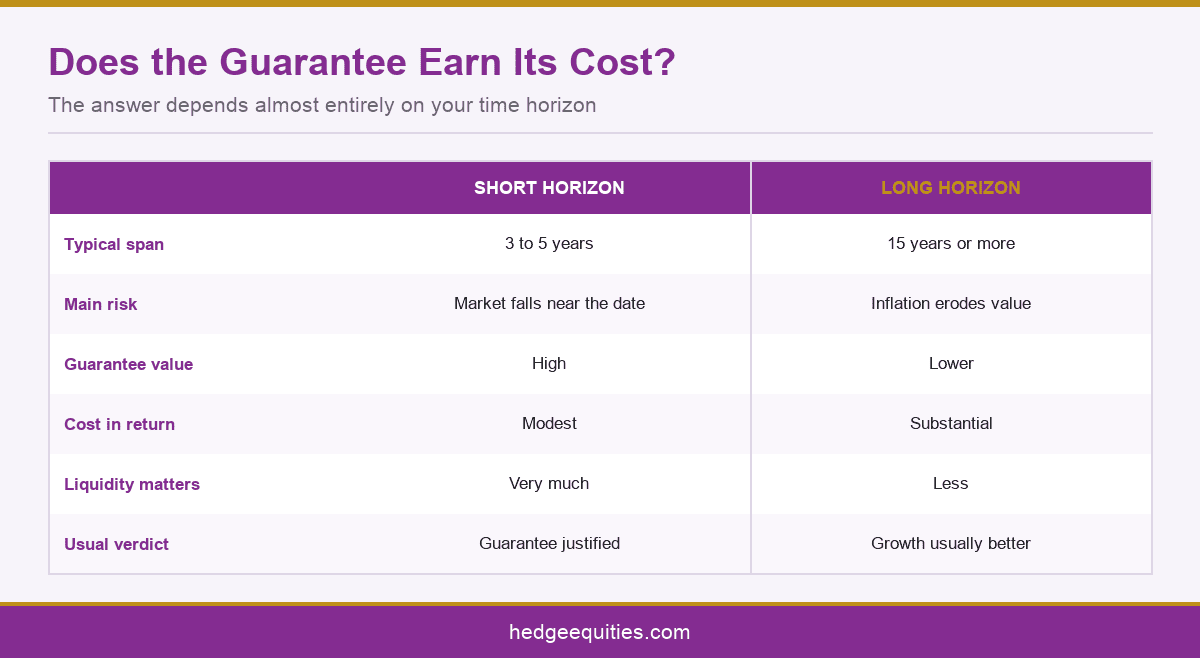
[Alt: Infographic showing how investment insurance guarantees are funded and what they cost investors] | File: infographic-1-where-the-guarantee-comes-from.png
Every link in the chain takes something before the promise reaches you.
How Much the Certainty Costs
Rather than asking whether a guaranteed rate is good, ask what it is being given up against. The comparison depends entirely on your time horizon, and that is where most conversations go wrong.
Over three to five years, the case for a guarantee is strong. Equity can and does fall over such periods, and an investor with a near term obligation cannot afford that. Over twenty years the picture inverts. Historically, diversified equity in India has delivered materially more than conservative debt over such spans, though never smoothly.
The honest framing is that you are buying insurance against a bad sequence of returns, and paying for it with expected return. That is a rational purchase when the obligation is fixed and near, and an expensive one when the horizon is long and the money is flexible. Category return data published by AMFI lets you check these comparisons yourself.
Consider the guarantee against your other holdings rather than in isolation. An investor whose portfolio is already dominated by fixed deposits and property gains very little from adding another conservative guaranteed holding. The same product bought by someone holding only equity may add genuine balance. Suitability is a portfolio question, not a product question.
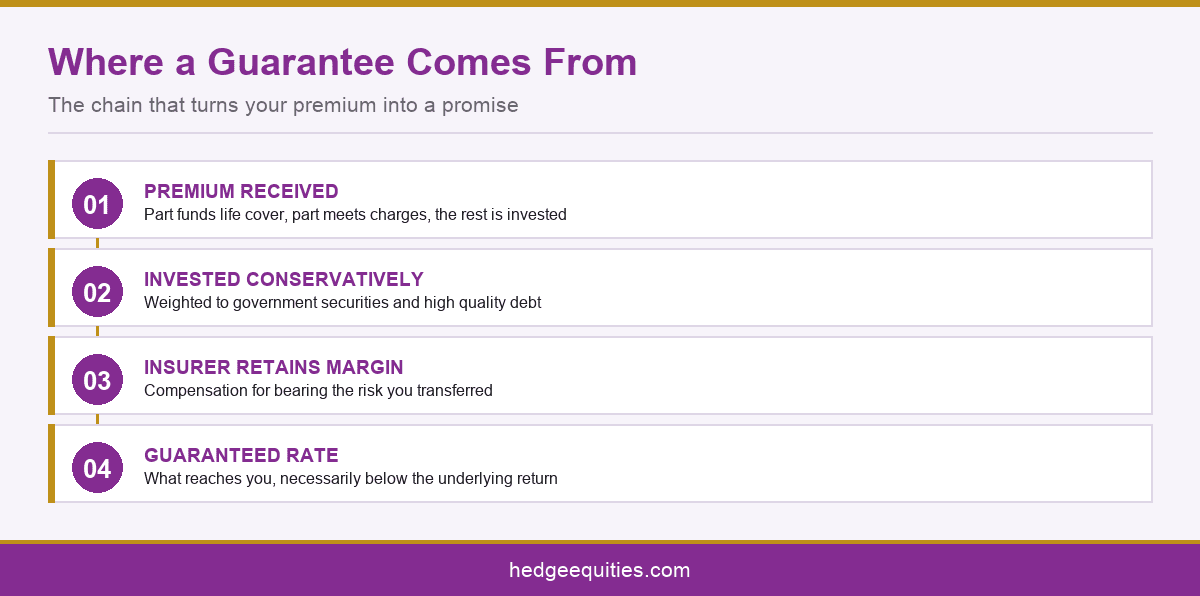
[Alt: Infographic comparing when investment insurance guarantees are worth their cost by time horizon] | File: infographic-2-guarantee-by-horizon.png
Short and fixed favours certainty. Long and flexible favours growth.
The Lock In You Should Price Separately
Illiquidity is a second and distinct cost, and it is the one investors most often underestimate. A guarantee you cannot exit is a very different product from one you can.
Unit linked plans carry a mandatory lock in of five years, during which no withdrawal is possible. Traditional policies have no formal lock in but acquire a guaranteed surrender value only after a minimum number of premiums, and early exit typically returns well below premiums paid. Either way, your money is committed.
Price that commitment honestly. If there is a realistic chance you will need these funds within the lock in, the guarantee is worth less to you than the brochure suggests, because the scenario in which you would need it most is the scenario in which you cannot access it. A financial health checkup that maps your emergency reserves is the practical way to test this before committing.
Partial withdrawal terms deserve a specific question. Some unit linked plans permit limited partial withdrawals after the lock in ends, subject to conditions. Others do not. Where a plan does allow them, the effective illiquidity is shorter than the headline suggests, and that materially changes what the lock in costs you.
Consider also what happens if you simply cannot continue premiums. Some plans allow a premium holiday or conversion to paid up status with reduced benefits, which is materially better than lapsing. Ask what options exist before you need them, because the answer differs sharply between products and is rarely raised at the point of sale.
When Investment Insurance Is the Right Answer
None of this argues against guarantees. It argues for buying them deliberately. There are clear situations where the certainty is worth more than the foregone return.
A known liability on a known date is the clearest case. If a specific sum is required for a child's education in eight years, a guaranteed instrument removes the risk that markets are down when the fee falls due. The certainty is not a luxury there, it is the entire point.
Retirement income is the second case. Once accumulation ends, sequence risk becomes the dominant threat, and a guaranteed floor beneath essential expenses is genuinely valuable. We compare the options for that specific need in our analysis of guaranteed income plans against debt funds and annuities.
A third case is estate planning. A guaranteed instrument with a clearly named nominee can pass a defined sum to a specific beneficiary with less friction than a portfolio requiring valuation and division. Where family circumstances make clean transfer a priority, that administrative simplicity carries real value quite apart from the return.
Questions to Ask Before You Commit
Four questions separate a considered purchase from a sold one. Ask them before signing, and insist on answers in rupees rather than percentages.
First, what is the internal rate of return on the guaranteed cash flows, computed from my own premium schedule? Second, what is the surrender value in years three, five and ten? Third, what portion of the projected maturity value is contractually guaranteed and what portion depends on future bonus declarations? Fourth, what is the tax treatment given my issue date and total premium?
A distributor who answers all four clearly is worth listening to. One who redirects to the projected maturity figure is not. If you want an independent view before committing, our advisory process includes exactly this assessment for investors across Kerala.
Insist on the answers in writing. A verbal assurance about surrender values or bonus expectations is worth nothing once a dispute arises, whereas the policy document and benefit illustration are binding. If a distributor is reluctant to put a claim in writing, treat that reluctance as the answer to your question.
Ask one further question before signing: what happens if the insurer's assumptions prove wrong? The contractually guaranteed portion holds regardless. Everything beyond it depends on outcomes nobody can promise, and understanding which part of your expected benefit sits in each category is the difference between a considered purchase and an optimistic one. Ask for both figures in rupees, side by side, before you sign anything.
Conclusion
Investment insurance is neither a trap nor a shortcut. It is a transfer of risk with a price attached, paid in foregone expected return and in liquidity. Buy it when you have a fixed obligation on a fixed date or need a floor beneath retirement income. Think harder when the horizon is long and the money is flexible. Talk to Hedge Equities before committing to a long term policy.
Frequently Asked Questions
What is investment insurance?
It refers to insurance products that combine life cover with an accumulation or guaranteed maturity component, including traditional endowment plans, guaranteed income plans and unit linked plans.
Are guaranteed returns really guaranteed?
The contractually guaranteed portion is. Many illustrations also include projected bonuses that are declared at the insurer's discretion and are not guaranteed. Ask which portion is which before signing.
Why are guaranteed returns lower than equity?
To honour a fixed promise the insurer must invest conservatively, mainly in government securities and high quality debt, and retain a margin for the risk assumed. Both reduce what can be passed on to you.
What is the lock in on a ULIP?
Unit linked plans carry a mandatory five year lock in during which no withdrawal is permitted. This is a regulatory requirement and applies regardless of the insurer or the specific plan.
Can I exit a traditional policy early?
You can surrender it, but typically only after a minimum number of premiums have been paid, and usually for well below premiums paid. Check the surrender value table before assuming an exit is affordable.
When is a guarantee worth paying for?
When you have a fixed obligation on a known near date, or need a reliable floor beneath essential retirement expenses. Over long flexible horizons the cost in foregone return is harder to justify.
How do I compute the real return on a guaranteed plan?
Enter each premium as a negative cash flow in the year paid and the guaranteed maturity value as a positive in the final year, then apply the internal rate of return function in a spreadsheet.
Is investment insurance taxable?
It can be. Thresholds differ by product type and issue date, and they test aggregate annual premium across policies rather than each policy alone. Confirm your position before assuming an exemption.
Does a guarantee protect against inflation?
No. A guaranteed nominal sum loses purchasing power over time. For long horizons this is a material consideration and argues for at least some growth exposure alongside any guaranteed holding.
What alternatives should I compare against?
Government securities, high quality bonds and conservative debt funds over the same period, since those carry comparable risk. Comparing a guarantee against a savings account flatters it.