
Search for private wealth management companies in India and almost every result is written for a Mumbai or Delhi audience: a metro professional with a single salary, a single city, and a straightforward succession picture. That is not the investor this guide is written for.
This is written for the ₹50 lakh-plus investor who holds a family business in Kochi or Thrissur, or who built wealth in the Gulf and now needs it managed, protected and eventually passed on across two jurisdictions. Hedge Equities is a SEBI-registered advisory and portfolio management firm built in and for Kerala, and this guide covers what a private wealth mandate actually contains, how it differs from standard PMS, and the concentration, succession and repatriation questions that a generic private-banking article never asks.
By the end of this guide you should be able to tell the difference between a firm that is genuinely offering a private wealth relationship and one that has simply relabelled a standard PMS brochure. That distinction matters more than any single return figure a provider quotes you in a first meeting.
Key Takeaways
A private wealth mandate is not just a bigger PMS account. Mandate terms, benchmark choice, exclusions and reporting depth are all negotiable above a certain portfolio size, and most investors never ask for that negotiation.
Kerala business families and Gulf NRI HNIs face concentration, succession and repatriation risks that national private banking content, written for salaried metro professionals, does not address.
SEBI registration, the Disclosure Document and the fee structure are the three things to verify before signing with any private wealth manager, not the brochure.
What Private Wealth Management Actually Means at This Scale
Below roughly ₹50 lakh in investable assets, most Indian investors are served by standardised products: mutual funds, a fixed set of model portfolios, a relationship manager who follows a script. Above that threshold, the relationship changes shape. A portfolio management service becomes possible under SEBI's PMS regulations, and above a few crore, the account starts to look less like a product and more like a mandate: a written agreement where the client and the manager negotiate what the portfolio will and will not hold.
That negotiation is the actual product at this scale. A private wealth management company is not selling a better return number. It is selling the ability to say 'no leverage in this sleeve,' or 'no direct exposure to my own listed company,' or 'benchmark this against a custom blend, not a standard index,' and have the manager build a mandate document that holds them to it.
This distinction matters because most of what gets published on this keyword nationally is written by firms selling to salaried metro professionals with a single income stream. Their content never has to address a promoter family's own listed shares sitting inside the same portfolio the manager is running, or a client who needs the portfolio's currency exposure managed against a Gulf salary. Those are Kerala and Gulf-NRI problems, and they need a different kind of advisor conversation.
It is also worth being clear about what private wealth management is not. It is not a guarantee of outperformance, it is not a way to avoid market risk, and it is not automatically available simply because a client asks for it. Many firms reserve genuinely bespoke mandates for clients above a specific internal threshold, often well above the SEBI PMS minimum, precisely because negotiating and monitoring individual exclusions and caps takes meaningfully more advisor time per client than running a standard model strategy.
Who This Guide Is For: The Kerala Business Family and the Gulf NRI HNI
Three investor profiles recur constantly in Hedge Equities' own client base, and each needs a slightly different private wealth conversation.
The first is the Kerala business family with a concentrated position: a promoter family whose wealth sits mostly in one company, one piece of land, or one family enterprise, and who are only now diversifying a portion of it into a managed portfolio. For this investor, the private wealth conversation is really a concentration-risk conversation first and a returns conversation second.
The second is the senior professional, often a doctor, a senior executive or a retired judge, who has built a seven-figure (in rupee terms, several crore) portfolio slowly through salary and equity over two or three decades and wants it managed with more structure than a mutual fund SIP can offer, but does not want the complexity of running it themselves.
The third is the Gulf NRI: someone earning in UAE dirhams, Saudi riyals or Qatari riyals, remitting a portion home, and needing that remitted wealth managed in India while staying compliant with FEMA rules on NRI investment and repatriation. This investor's private wealth mandate has to account for currency timing, repatriation documentation, and a tax residency picture that a purely domestic private banking article never touches.
A fourth, smaller but growing group sits between the first and third: the second generation of a Gulf-origin Kerala family, often now resident in India or moving between both, inheriting wealth that was accumulated abroad but now needs to be managed and eventually passed on under Indian rules. Their planning conversation borrows from both the business-family and the NRI playbook at once, which is exactly why a generic metro private-banking framework tends to fail them.
Standard PMS vs a Private Wealth Mandate: Where the Line Sits
SEBI's Portfolio Managers Regulations set ₹50 lakh as the minimum investment threshold for a discretionary or non-discretionary PMS account. That threshold is a regulatory floor, not a description of what a private wealth mandate looks like once a portfolio grows well past it.
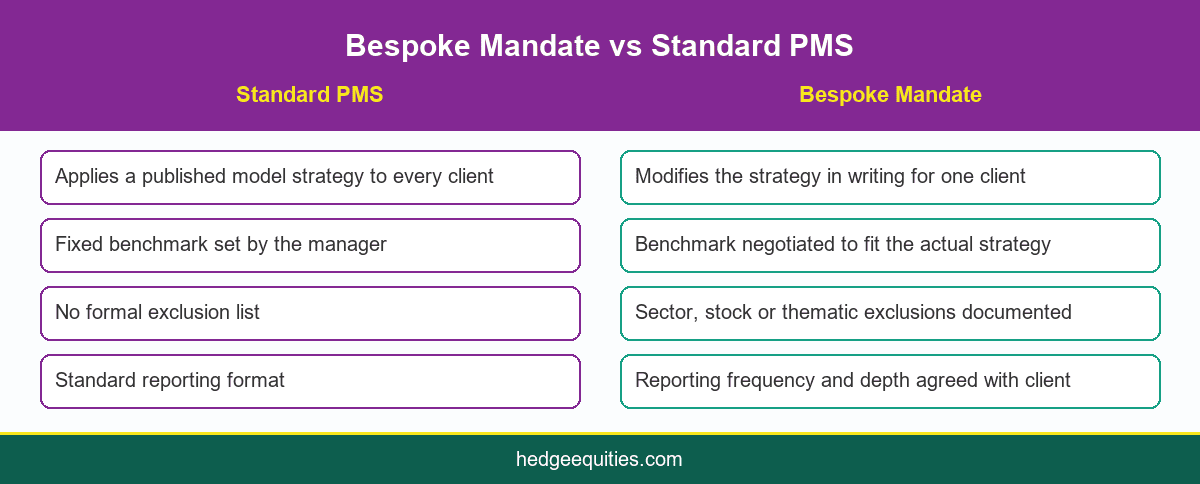
Standard PMS, run at or near the regulatory minimum, typically follows one of a small number of published model strategies. The client picks a strategy, not a set of terms. A private wealth mandate, by contrast, is negotiated line by line: which sectors or single stocks are excluded, what the maximum single-position weight is, which benchmark the portfolio is measured against, and how often and in what format reporting is delivered.
This negotiation is precisely the subject of cluster 3.1 on bespoke PMS mandates, which walks through exclusions, concentration caps and benchmark choice in detail. The short version here: if your PMS agreement reads exactly like the standard published strategy document with your name and a number filled in, you are not yet getting a private wealth mandate, whatever the manager calls it.
One practical marker to look for: ask what changes in your mandate document if your circumstances change, for example if you sell a business stake and need to deploy a large lump sum, or if you need to draw a fixed income stream from the portfolio for a period. A standard PMS strategy usually cannot flex for this without moving you into a different published product. A true private wealth mandate should be able to amend its own terms through a documented process rather than requiring you to exit and re-enter.
Building the Portfolio: Equity, Debt, AIFs and Unlisted Opportunities
A private wealth portfolio at scale is rarely pure listed equity. It typically blends direct equity and debt held under the PMS mandate with an allocation to Alternative Investment Funds, which under SEBI's AIF Regulations carry a considerably higher minimum investment than PMS itself and are structured in three categories: Category I (venture capital and infrastructure-focused funds), Category II (private equity and debt funds without leverage or complex structuring), and Category III (funds using more complex or leveraged strategies, including some listed-market hedge strategies).
AIFs solve a real problem for HNI investors: access to opportunities, unlisted businesses, structured credit, pre-IPO rounds, that a standard PMS mandate cannot legally or practically hold. But they come with a real cost: multi-year lock-ins, limited or no secondary liquidity, and a return profile that can take years to prove out. Cluster 3.2 covers the liquidity question in AIFs and unlisted shares in detail, including what happens if a client needs to exit early.
The honest framing for a Kerala business family or a Gulf NRI HNI is this: AIF and unlisted allocations should be sized against money the family will not need on a fixed date, not against the whole private wealth mandate. A manager who structures the entire portfolio around illiquid sleeves is optimising for their own fee arrangement, not for the client's liquidity reality.
Fixed income and debt allocations deserve equal attention in this mix, even though they generate less conversation than equity or AIFs. For a client drawing income from the portfolio, whether a retired professional or a family living partly off portfolio distributions, the debt sleeve is what funds near-term cash needs while the equity and AIF sleeves are left to compound. Getting the split between these buckets wrong is a more common cause of investor disappointment than picking the wrong individual stock.
The Risks Metro Private Banking Playbooks Miss
Concentration risk is the first and most common blind spot. A promoter family whose net worth is 70 or 80 percent tied to one listed or unlisted business is running a single-stock risk that no amount of diversification inside the remaining 20 percent can offset. A private wealth manager's first job with this client is often not portfolio construction at all, it is a frank conversation about how much of the family's core holding can realistically and tax-efficiently be reduced over time, and where the proceeds should sit while that process plays out. Cluster 4.6, which is written for exactly this concentrated-holdings situation, goes deeper into single-stock and family-business concentration specifically.
Succession is the second blind spot. Kerala business families frequently run wealth and business ownership through joint family arrangements, HUFs, or informal understandings between siblings that were never documented as clearly as they should have been. A private wealth mandate that ignores who inherits what, and under which structure, is building a portfolio for a family that may not exist in its current form ten years from now.
Repatriation is the third, and it is specific to the Gulf NRI investor. Money invested in India by an NRI is subject to FEMA rules on repatriation: which account it was routed through (NRE versus NRO), what documentation supports the original remittance, and what the current repatriation limits and reporting requirements are. A private wealth manager serving Gulf-NRI clients needs to structure the portfolio, and the paperwork behind it, so that repatriation is a formality when the client needs it, not a six-month scramble for old remittance certificates.
A fourth, quieter risk is advisor concentration itself: relying on a single relationship manager who holds all the institutional knowledge about a family's structure and history. When that individual leaves the firm, families sometimes discover that critical context, why a mandate excludes a certain sector, what the succession plan actually says, was never written down anywhere beyond that person's own notes. Insisting that this context lives in the mandate document and firm records, not one person's memory, is a simple but frequently skipped safeguard.
How to Vet Any Private Wealth Manager Before You Sign
Three checks matter more than any brochure. First, confirm the firm's SEBI registration directly rather than taking a business card at face value; the SEBI website carries the official intermediary registers for portfolio managers and research analysts. Second, read the mandatory Disclosure Document before signing anything, since this is where fee structure, past performance disclosure rules and conflict-of-interest arrangements are legally required to appear, not summarised in a sales deck. Third, understand exactly how the manager is paid: a flat management fee, a profit-share above a hurdle rate, or a blend of both, and what happens to that fee structure if the portfolio underperforms.
Registration and Disclosure Document Checks
This exact due-diligence walkthrough, including how to read a PMS Disclosure Document line by line and how to compare a fixed fee against a profit-share model, is the subject of cluster 3.3, How to Vet a PMS Service Provider. Treat it as the required second read before signing any mandate this guide has described.
Beyond the paperwork, ask for references from existing clients with a similar profile to yours, ideally another business family or NRI client rather than a generic testimonial. A firm confident in its private wealth process should be comfortable facilitating this, within the bounds of client confidentiality.
Fees, Alignment and What to Expect at This Scale
Fee conversations at the private wealth level are rarely a single number. Expect a base management fee, often lower than a standard PMS strategy's headline rate given the larger ticket size, combined with a profit-share above an agreed hurdle. Ask specifically how the hurdle is calculated, whether it resets annually or accumulates, and what happens in a year where the portfolio is flat or down.
Alignment matters as much as the headline number. A fee structure weighted heavily toward a fixed component gives the manager less incentive to take outsized risk chasing performance fees, while a structure weighted toward profit-share can align incentives well in strong markets but may tempt a manager toward higher-risk positioning in a weak one. Neither structure is inherently wrong, but you should understand which one you are signing and why the firm structured it that way for your account specifically.
What Hedge Equities Offers HNI Clients in Kerala and the Gulf
Hedge Equities holds SEBI's Portfolio Manager registration (PMS-INP000003476) and Research Analyst registration (RA-INH000004398), and works with Kerala business families, senior professionals and Gulf-NRI clients on exactly the mandate, concentration, succession and repatriation questions this guide has raised. The starting point for any of these conversations is the firm's Portfolio Management Services page, and for clients still building toward the PMS minimum, the firm's Financial Health Checkup is the right first step.
For investors comparing the systems and reporting infrastructure behind a modern PMS mandate, not just the strategy, the Hedge Equities guide to portfolio management platforms covers what a digital-first advisor can and cannot do under current SEBI rules.
Because the firm is based in Kerala with an established Gulf-NRI client base, conversations about repatriation documentation, family succession structures and concentrated business holdings are handled as a routine part of onboarding, not as an unusual exception a metro-focused private bank has to escalate internally.
A Practical First Step If You Are Not Sure Where You Stand
Not every reader of this guide is ready to sign a private wealth mandate today. Some are a few years away from the ₹50 lakh PMS threshold, others are past it but have never had their existing holdings, insurance and succession picture reviewed together in one sitting. Both situations benefit from the same first step: a structured review before a portfolio decision, not after one.
A financial health review should surface three things clearly: how much of your net worth sits in a single concentrated position, whether your insurance cover matches your actual dependents and liabilities today rather than when the policy was first bought, and whether your family's succession intentions are actually documented anywhere a lawyer or advisor could act on if needed. Most investors, regardless of net worth, discover at least one gap in this review the first time they go through it properly.
For investors below the PMS threshold today, our guide to portfolio management for small and first-time investors covers what to do with that capital in the meantime, and how to build toward a private wealth conversation deliberately rather than by accident.
How Hedge Equities' Digital Reporting Supports a Private Wealth Relationship
A private wealth mandate is only as useful as the reporting behind it. Exclusions, concentration caps and a custom benchmark are meaningless if the periodic report a client receives cannot actually show whether those terms are being honoured month to month. This is where the systems and reporting infrastructure question, covered in depth in our guide to portfolio management platforms, becomes directly relevant to a private wealth client, not just a digital-first retail investor.
For a Gulf-NRI client managing a Kerala-based mandate from overseas, this reporting infrastructure matters even more, since in-person meetings happen less frequently and a clear digital report often has to carry more of the ongoing relationship than it would for a locally based client.
Common Mistakes This Guide Is Written to Prevent
The most common mistake is treating private wealth management as a status upgrade rather than a functional negotiation. Investors who sign with a well-known name without insisting on the specific mandate terms covered in this guide often end up with standard PMS management at a premium price, simply because they never asked the questions that would have surfaced the difference.
The second most common mistake is addressing concentration, succession and repatriation as separate, occasional conversations rather than as inputs the portfolio manager should hold continuously. A family business sale, a change in a Gulf-NRI client's country of residence, or a shift in succession intentions should trigger a mandate review, not wait for the next scheduled annual meeting to surface.
The third is underestimating how much advisor continuity matters at this scale. A private wealth relationship intended to run for a decade or more is poorly served by a firm structured around individual relationship managers with no documented handover process. Ask about this directly, as covered in our PMS vetting guide, before you commit to a long-term relationship.
A fourth, smaller mistake worth naming: comparing private wealth providers purely on quoted historical returns without adjusting for the specific mandate constraints each provider was managing under. A manager running an unconstrained standard strategy and a manager running a heavily constrained bespoke mandate for a concentrated business family are not directly comparable on headline return alone, since the second manager is deliberately managing around limitations the first never had to consider.
Keep this whole guide in mind as a starting checklist rather than a finished decision. The right private wealth relationship for a Kerala business family looks different from the right one for a Gulf-NRI professional, and both differ again from a senior executive nearing retirement. What should not differ is the standard of verification: registration confirmed independently, terms documented in writing, and a fee structure you understand well enough to explain back to someone else.
Conclusion
Private wealth management is not a bigger version of a retail mutual fund SIP, and it should not be sold as one. It is a negotiated mandate that has to account for what makes a Kerala business family or a Gulf NRI HNI's situation genuinely different from a metro salaried professional's: concentration in a single family business, succession across generations, and repatriation across borders. Start by verifying the manager's SEBI registration and reading the Disclosure Document, then use the linked guides above to go deeper into mandates, AIFs, vetting and concentrated-holding risk. If you are ready to have this conversation directly, Hedge Equities' Portfolio Management Services team works with exactly this client profile every day.
Investments in securities market are subject to market risks. Read all the related documents carefully before investing. Hedge Equities Ltd is registered with SEBI as a Portfolio Manager (PMS-INP000003476) and a Research Analyst (RA-INH000004398). This article is for general educational purposes and does not constitute personalised investment advice; please consult a registered advisor before making investment decisions.
Frequently Asked Questions
What is the minimum investment for private wealth management in India?
SEBI sets a ₹50 lakh minimum for portfolio management services. Private wealth mandates with negotiated terms, custom benchmarks and AIF access typically start well above that floor, often in the low crores, though the exact figure varies by firm.
Are private wealth management companies regulated by SEBI?
Portfolio management activity is regulated under SEBI's Portfolio Managers Regulations, and research or advisory activity separately under the Research Analyst and Investment Adviser regulations. Always verify a firm's specific registration category before investing.
How is private wealth management different from asset management?
Asset management typically refers to running pooled products like mutual funds against a published strategy. Private wealth management negotiates individual mandate terms for one client. See our guide on wealth management vs asset management for a full comparison.
Can NRIs use portfolio management services in India?
Yes, NRIs can invest in PMS through NRE or NRO accounts under FEMA rules, though documentation and repatriation procedures differ by account type. A Kerala-based advisor familiar with Gulf-NRI clients can structure this correctly from the start.
What is the minimum investment in an AIF in India?
SEBI's AIF Regulations set a considerably higher minimum than PMS, generally around ₹1 crore for most investors, with a lower threshold for fund employees and directors. Always confirm the current figure with the fund's own offer document.
How do private wealth managers charge fees?
Common structures include a flat annual management fee, a profit-share above a hurdle rate, or a blend of both. The exact structure must be disclosed in the mandatory Disclosure Document before you invest.
What should a Kerala business family ask before hiring a private wealth manager?
Ask how the manager handles concentration in the family's core business holding, how succession and family ownership structures factor into portfolio decisions, and request the SEBI registration number and Disclosure Document directly.
Is private wealth management only for metro city investors?
No. Kerala business families and Gulf-NRI HNIs have distinct concentration, succession and repatriation needs that a Kerala-based, SEBI-registered advisor is often better positioned to address than a purely metro-focused private bank.
What documents should I check before signing a PMS mandate?
Request the SEBI registration confirmation, the full Disclosure Document, and a written fee schedule. Never rely on a verbal summary or a marketing brochure alone before signing a mandate agreement.
How is a private wealth mandate different from a standard PMS strategy?
A standard PMS strategy is a published model portfolio applied uniformly to clients. A private wealth mandate negotiates exclusions, concentration caps and benchmark choice specifically for one client's situation, as covered in our guide to bespoke PMS mandates.