

Few decisions confuse Indian savers more than the question of whether insurance and investment belong in the same product. A relative recommends an endowment plan. A bank suggests a unit linked policy. A colleague swears by a term plan plus a mutual fund. All three cannot be right for the same person. This guide sets out how the two functions actually work, what the tax law now says, and the sequence we use atHedge Equities when a client asks which route suits them.
Key Takeaways
- Insurance prices risk. Investment prices growth. A single product that tries to do both usually does one of them poorly, and the cost of that compromise is rarely visible on the brochure.
- Tax law has moved decisively. Traditional policies issued from 1 April 2023 lose their maturity exemption once aggregate annual premium crosses five lakh rupees, and unit linked plans lose theirs above two and a half lakh rupees back in February 2021.
- Bundling still makes sense for a minority of investors. Knowing whether you are in that minority is the entire decision, and it depends on your discipline, your tax slab and your time horizon.
What Insurance and Investment Each Actually Do
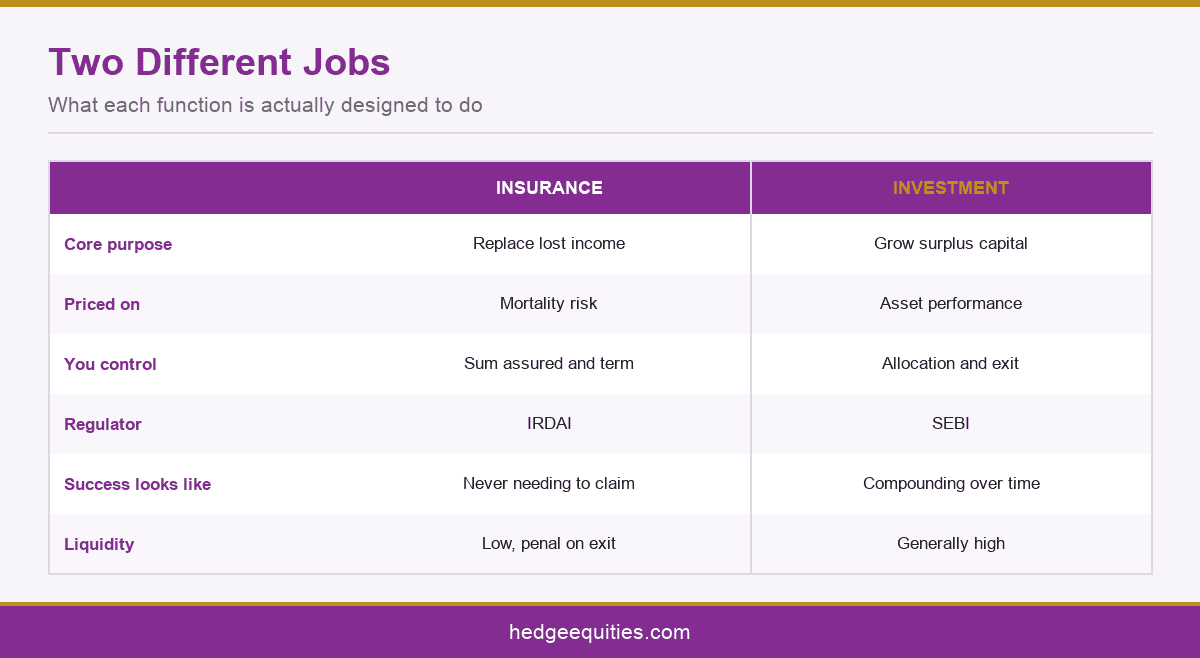
Insurance and investment answer two different questions. Insurance answers what happens to the people who depend on you if your income stops. Investment answers how your surplus grows once that dependency is already covered. Treating them as interchangeable is the root of most poor product choices in Indian households.
An insurer pools premiums from many policyholders and pays out to the few who claim. The price you pay reflects mortality risk, the insurer's expenses and a margin. None of that is designed to compound your wealth. An investment vehicle, by contrast, puts your money to work in equity, debt or a blend, and your outcome tracks those underlying assets net of costs.
When a product bundles both, your premium splits. One part buys cover, another meets charges, and only the remainder is invested. That remainder is what compounds. Understanding this split is the single most useful thing an investor can learn, and it is examined in detail in our guide towhat returns life insurance investments actually deliver.
Kerala households add a further layer to this. Gulf remittance income, joint family property and the cultural weight attached to gold all shape how protection and growth get discussed at home. A plan that ignores those realities may be technically correct and still fail to be followed, which is the only test that ultimately matters.
The role of the regulator
Insurance products in India are regulated by theInsurance Regulatory and Development Authority of India, while mutual funds, portfolio management services and research analysts fall underSEBI. The two regimes have different disclosure standards. This is one reason a policy illustration and a mutual fund factsheet can look so different even when they describe similar exposure.
Why the confusion persists
Distribution economics explain much of it. Commission structures on bundled products have historically been considerably richer, and front loaded, compared with term cover or a direct mutual fund plan. That does not make bundled products wrong. It does mean the recommendation you receive may not be neutral, so the burden of checking falls on you.
Why the Two Are Usually Better Kept Separate
For most working Indians, buying pure term cover and investing the difference produces a better outcome than a bundled plan. The reason is structural rather than ideological. Pure term cover is the cheapest way to buy a given sum assured, because you are paying for mortality risk and nothing else. Every rupee you do not spend on charges stays available to the compound.
Separating the two also gives you control. If your fund underperforms, you can switch without touching your cover. If your income rises and you need more protection, you can top up the term plan without disturbing your portfolio. In a bundled product these levers are welded together, and pulling one usually damages the other.
Liquidity is the third argument. Asystematic investment plan can be paused, reduced or redeemed. A traditional policy surrendered in its early years typically returns a fraction of the premiums paid. Investors rarely plan to surrender, yet a meaningful share does, and the cost of that exit is where bundled products quietly destroy value. We run that comparison in full, with the twenty year arithmetic set out step by step, in our guide to choosing between a unit linked plan and term cover plus a systematic investment plan.
There is also an accountability argument that rarely gets made. When insurance and investment sit in separate products, you can evaluate each on its own terms. The term plan is judged purely on cost per rupee of cover. The fund is judged purely on net return against its benchmark. Bundle them and neither judgement is possible, because a disappointing outcome can always be attributed to the other half.
This matters over long periods. Twenty years is long enough for an underperforming fund to cost you a great deal, and long enough for a cheaper term plan to become available. Separation lets you act on both. A bundled contract generally does not, and by the time the shortfall is obvious the surrender cost has usually made switching uneconomic.
None of this is an argument that insurers behave badly. They are running a different business with different obligations, supervised under a solvency regime that requires them to hold capital against every promise made. Those obligations shape the product. Recognising that is more useful than treating the question as a contest between honest and dishonest institutions, because it explains why the economics come out as they do.
The cost of bundling
Bundled policies carry premium allocation charges, policy administration charges, mortality charges and fund management charges. Each is disclosed, but they appear in different places and different units, which makes the total hard to feel. A useful discipline is to ask your distributor for the total charge in rupees over the full term, not as a percentage in year one.
Where the returns go
In a participating traditional plan your return arrives largely as bonuses declared at the insurer's discretion out of a profits fund. You do not choose the asset allocation, you cannot see daily valuation, and the bonus is not guaranteed until declared. That is a very different proposition from holding units whose value you can check every day.
The Tax Rules That Changed the Maths
Two amendments reshaped this decision, and any advice given before them is now out of date. Investors who bought bundled plans largely for the tax exemption need to re read their own assumptions, because the exemption they were sold may no longer apply.
The direction of travel is clear. Parliament has progressively narrowed the tax advantage that high premium insurance once enjoyed, moving it closer to how other investments are treated. Deduction on premium paid under Section 80C, capped at one and a half lakh rupees, remains available only under the old tax regime, which fewer taxpayers now choose.
Verify your own position against theIncome Tax Department before assuming an outcome. The rules turn on policy issue date and on aggregate premium across policies, not on any single policy in isolation, which is a detail that catches many investors out.
A practical consequence deserves emphasis. Because the thresholds test aggregate annual premium across policies rather than any single policy, buying several smaller plans does not sidestep them. Investors who hold three or four policies bought in different years should total their annual premium before assuming any of them remains exempt.
Note too that these amendments apply prospectively. A policy issued before the relevant date keeps its original treatment for its full term. This creates a genuine asymmetry between older and newer holdings, and it is a reason not to surrender an older policy without first checking what tax position you would be giving up.
Traditional policies issued from April 2023
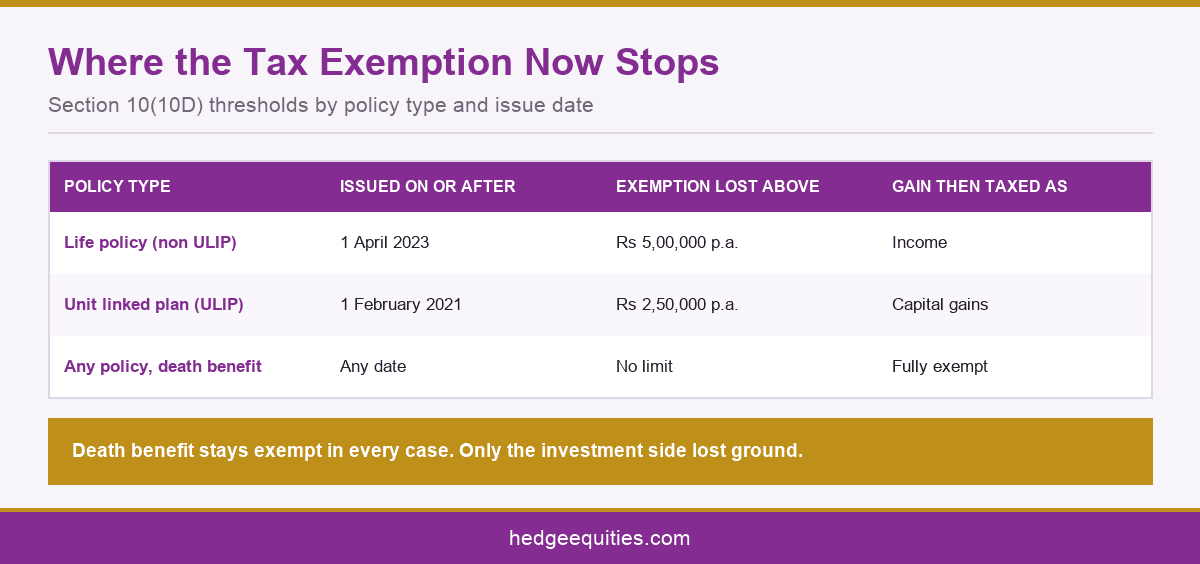
For life insurance policies other than unit linked plans issued on or after 1 April 2023, the Section 10(10D) maturity exemption no longer applies where aggregate annual premium across such policies exceeds five lakh rupees. Proceeds on those policies become taxable. Policies issued before that date are not affected.
Unit linked plans issued from February 2021
For unit linked plans issued on or after 1 February 2021, the exemption is lost where aggregate annual premium exceeds two and a half lakh rupees, and gains are taxed as capital gains. Plans issued before that date remain exempt regardless of premium.
What did not change
The death benefit remains exempt under Section 10(10D) in every case, whatever the premium and whatever the issue date. This matters, because it means the protection function of insurance kept its tax treatment while the investment function largely lost its advantage.
Where Combining Insurance and Investment Genuinely Works
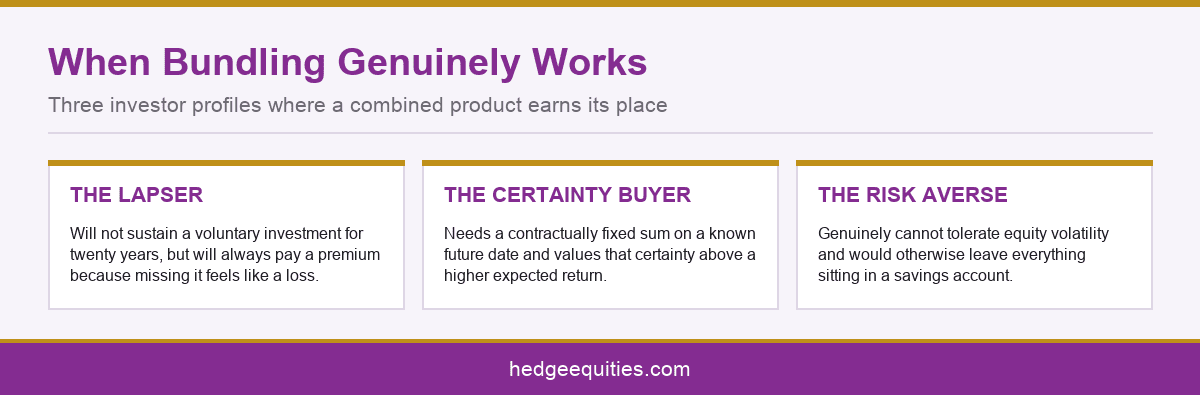
The separate route is right for most people, but not for everyone, and pretending otherwise is its own kind of mis-selling. Three situations justify a bundled product on their own merits rather than on a tax argument that may no longer hold.
The first is behavioural. Some savers simply will not sustain a voluntary investment over twenty years, but will pay a premium because a lapse feels like a loss. For that investor, a mediocre return actually beats an excellent return abandoned in year three. The second is the investor who needs a contractually certain sum on a fixed future date, for a child's education or a known liability, and values that certainty above expected return.
The third is the investor whose risk tolerance genuinely cannot absorb equity volatility, and who would otherwise hold everything in a savings account. We look at all three profiles closely in our analysis of when combining life insurance and investment works, including how to tell which one describes you. Retirement income is a closely related case, and we compare the instruments built for it in our analysis of guaranteed income plans against debt funds and annuities.
What unites all three profiles is that the case rests on something other than expected return. That is the honest test to apply when a bundled plan is recommended to you. If the argument offered is that the returns are competitive, be sceptical. If the argument is that you will actually stick with it, or that you need a fixed sum on a fixed date, the recommendation deserves a proper hearing.
It is equally worth naming who does not fit. An investor who already maintains a monthly investment through market falls, whose goals are flexible in both amount and timing, and who has a horizon beyond fifteen years, is paying for a commitment device they demonstrably do not need.
One practical safeguard applies to all three profiles. Even where a bundled product is the right answer, it should not be the only answer. A household relying entirely on a single long dated contract has concentrated both its protection and its savings in one counterparty and one product design. Holding some separate liquid savings alongside preserves the ability to respond to events the contract never anticipated.
How to Size Protection Before You Invest
Protection comes first in any sound plan, and not because insurance is more important than investing. It comes first because an uninsured portfolio is not really a portfolio. It is a reserve that will be liquidated at the worst possible moment if something goes wrong.
Two methods dominate. The income replacement method multiplies annual income by the number of years your dependents would need support, commonly ten to fifteen times for someone in their thirties. The human life value method is more precise, discounting future earnings net of your own consumption and adding outstanding liabilities.
Whichever method you use, add outstanding home and vehicle loans, subtract existing cover and liquid assets, and revisit the number whenever your income, family size or debt changes. Health cover sits alongside this. A single hospitalisation without adequatehealth insurance can undo several years of disciplined investing, which is why we treat it as part of the portfolio conversation rather than a separate errand.
Two further exposures belong in the protection layer and are routinely missed. Employer group cover usually terminates with the employment, often at the exact moment when buying individual cover is hardest and most expensive. Treat it as a supplement, never as the foundation of your protection.
Critical illness and disability cover address a different failure again. Death is not the only way an income stops. A serious illness can end earning capacity while household expenses continue and medical costs rise, which is the scenario most likely to force the sale of long term holdings at short notice.
A working sequence
Establish emergency savings of six months of expenses, buy adequate term and health cover, clear high cost debt, and only then direct surplus into growth assets. Our detailed treatment of how much cover an investor should hold works through the calculation with a full example.
Reading a Policy Illustration Without Being Misled
Every life insurance illustration in India shows projected values at two gross investment return assumptions. Those are illustrative rates prescribed for comparison, not forecasts, and the higher figure is not what you should expect. The number that matters is the net yield to you after all charges, and it is almost never printed on the front page.
Compute it yourself. Take every premium you will pay and the maturity value shown, and calculate the internal rate of return. Any spreadsheet will do this in seconds. Compare that figure against what a comparable debt instrument or abond portfolio would return over the same period, and against equity over a long horizon.
Then look at the surrender value table, which is usually printed near the back. It tells you what you receive if you exit in year three, year five and year ten. For many traditional plans those figures are sobering, and they are the honest measure of how much flexibility you are giving up. Our detailed treatment of what guarantees and lock ins actually cost explains why certainty is priced the way it is, and how to judge whether you are paying a fair price for it.
One more figure deserves attention: the guaranteed portion of the maturity value. Many illustrations combine a contractually guaranteed sum with projected bonuses that are declared at the insurer's discretion. Only the first is a promise. Ask for the two to be shown separately, in rupees, and treat the projected element as a possibility rather than a plan.
Applying the same discipline to any investment product is good practice. Historical category returns for mutual funds are published byAMFI, and past performance carries no obligation either. The difference is that a fund's costs and holdings are disclosed in a standard format that makes comparison straightforward.
Finally, read the exclusions. A benefit illustration describes what happens when everything proceeds normally. The policy wording describes what happens when it does not, including suicide clauses, non disclosure consequences and the circumstances in which a claim can be contested. Those clauses decide whether the protection you bought actually pays, which makes them considerably more important than the projected maturity figure most buyers focus on.
Gross returns versus net returns
A plan illustrated at a gross rate can deliver a materially lower net yield once allocation, administration and mortality charges are deducted. The gap is widest in the early years, which is precisely when investors are most likely to need their money back.
The surrender value trap
Traditional policies typically acquire a guaranteed surrender value only after a minimum number of premiums have been paid, and even then at a fraction of premiums paid. If there is any real chance you will need this money within a decade, that risk should decide the product, not the projected maturity figure.
A Practical Sequence for Indian Investors
Start with a clear picture of where you stand. A structuredfinancial health checkup establishes your income, liabilities, existing cover and current holdings before any product enters the conversation. Recommendations made without that baseline are guesses, however confident they sound.
Next, separate the two decisions deliberately. Decide your protection number and buy it in the cheapest compliant form. Then decide your growth allocation and select vehicles on their own merits, whether that is asystematic investment plan, directequity,bonds or a discretionaryportfolio management service once you cross the regulatory minimum.
Finally, review annually. Cover needs rise with income and family responsibility and fall as loans amortise and children become independent. Portfolios drift from their target allocation. An annual review catches both. If you would like that review conducted by a SEBI registered firm, you canspeak to our team in Kochi. The wider sequencing framework, from establishing a baseline through to the annual review, is set out in our guide to financial planning that balances protection and growth.
Sequence the review as carefully as the plan. Confirm the protection number first, because it is the figure most likely to have moved. Rebalance the allocation second, since drift raises your risk quietly and without any decision on your part. Revisit the goals last, because a plan built around goals you no longer hold will steer you accurately toward the wrong place.
Investors in Kerala and the Gulf face one additional consideration. Residency status affects taxation, repatriation and product eligibility, and it can change during the life of a long term policy. If your status is likely to shift, factor that in before committing to a contract running two decades. Our guide towho we serve sets out the profiles we work with most often.
Conclusion
The honest answer to the insurance and investment question is that they are two jobs, and combining them should be a deliberate choice rather than a default. For most Indian investors, adequate term and health cover alongside a separate growth portfolio delivers more protection and more wealth for the same outlay. For a minority with specific behavioural or certainty needs, a bundled plan earns its place. Work out which group you belong to before you sign anything.Talk to Hedge Equities if you want that worked through against your actual numbers.
Frequently Asked Questions
Is insurance an investment?
Insurance is primarily protection, not investment. Some policies do carry an investment component, but the returns are usually lower than dedicated investment vehicles because part of every premium funds cover and policy charges rather than growth.
Should I buy insurance and investment separately?
For most Indian investors, yes. Pure term cover plus a separate growth portfolio typically delivers both higher protection and higher expected wealth for the same annual outlay, because charges are lower and each decision can be changed independently.
Is life insurance maturity still tax free in India?
Not always. For policies other than unit linked plans issued from 1 April 2023, the exemption is lost where aggregate annual premium exceeds five lakh rupees. Death benefit remains exempt in all cases.
What is the tax rule for ULIPs?
For unit linked plans issued on or after 1 February 2021, maturity proceeds lose the exemption where aggregate annual premium exceeds two and a half lakh rupees, and the gain is taxed as capital gains instead.
How much life cover do I need?
A common starting point is ten to fifteen times annual income, adjusted upward for outstanding loans and downward for existing cover and liquid assets. Review it whenever income, family size or debt changes.
Do I need health insurance if I already invest?
Yes. A single major hospitalisation can force you to liquidate investments at a poor moment. Adequate health cover protects the portfolio itself, which is why it belongs in the plan rather than beside it.
Are guaranteed income plans a good investment?
They suit investors who value contractual certainty over expected return. The rate onguaranteed income plans sits below long term equity returns, so the question is whether that certainty is worth the difference.
Can I surrender a policy early without loss?
Rarely. Traditional policies typically acquire surrender value only after a minimum number of premiums, and early exit often returns well below premiums paid. Check the surrender value table before committing.
Who regulates insurance and investment products in India?
Insurance falls under the Insurance Regulatory and Development Authority of India. Mutual funds, portfolio managers and research analysts fall under SEBI. Complaints can be raised through their respective grievance portals.
Where should I start if I have neither cover nor investments?
Begin with a baseline review of income, liabilities and dependants. Ouradvisory process establishes that picture first, then sizes protection, then allocates the surplus to growth assets.