
Life Insurance and Investment: When Combining Them Works
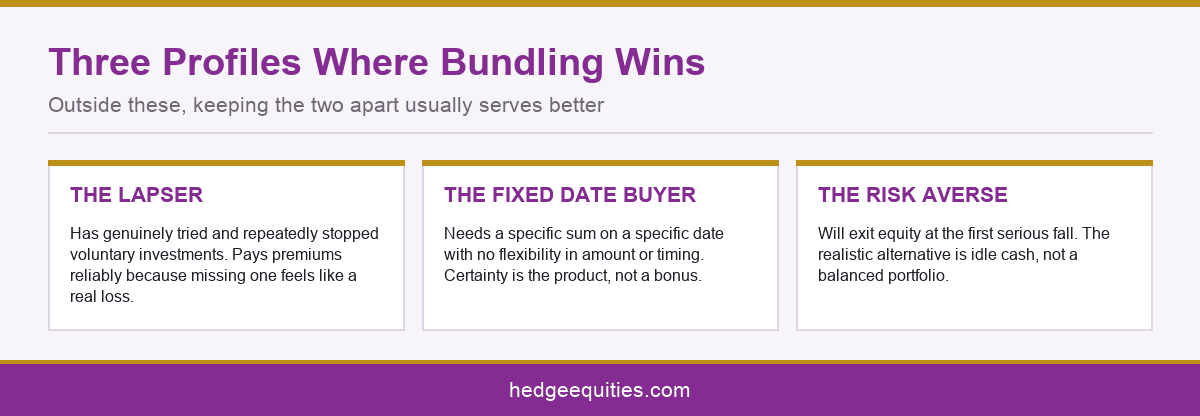
The standard advice is to keep life insurance and investment apart, and for most Indian investors that advice is sound. But standard advice applied without judgement becomes its own form of mis selling. There are three investor profiles for whom a combined product is genuinely the better answer. This article describes them precisely, so you can tell whether you are one.
Key Takeaways
The case for combining is behavioural and situational, not mathematical. If someone defends a bundled plan purely on returns, they are defending it on the wrong ground.
Two of the three profiles depend on honest self assessment rather than on any calculation, which makes them uncomfortable to judge but no less real.
Profile One: The Investor Who Will Not Sustain a SIP
This is the strongest honest argument for combining, and it has nothing to do with returns. It concerns the difference between what an investor intends to do and what they actually do over twenty years.
A premium notice carries obligation. Missing it feels like a failure with consequences. A voluntary monthly investment carries no such weight, and skipping one feels like a postponement rather than a loss. That asymmetry is well documented and it is not a character flaw. It is how commitment devices work.
For an investor who has genuinely tried and repeatedly stopped, a mediocre return actually achieved beats an excellent return abandoned in year three. The honest test is your own history. If you have started and stopped voluntary investments more than once, this profile may describe you. If you have maintained a systematic investment plan through a market fall without flinching, it does not.
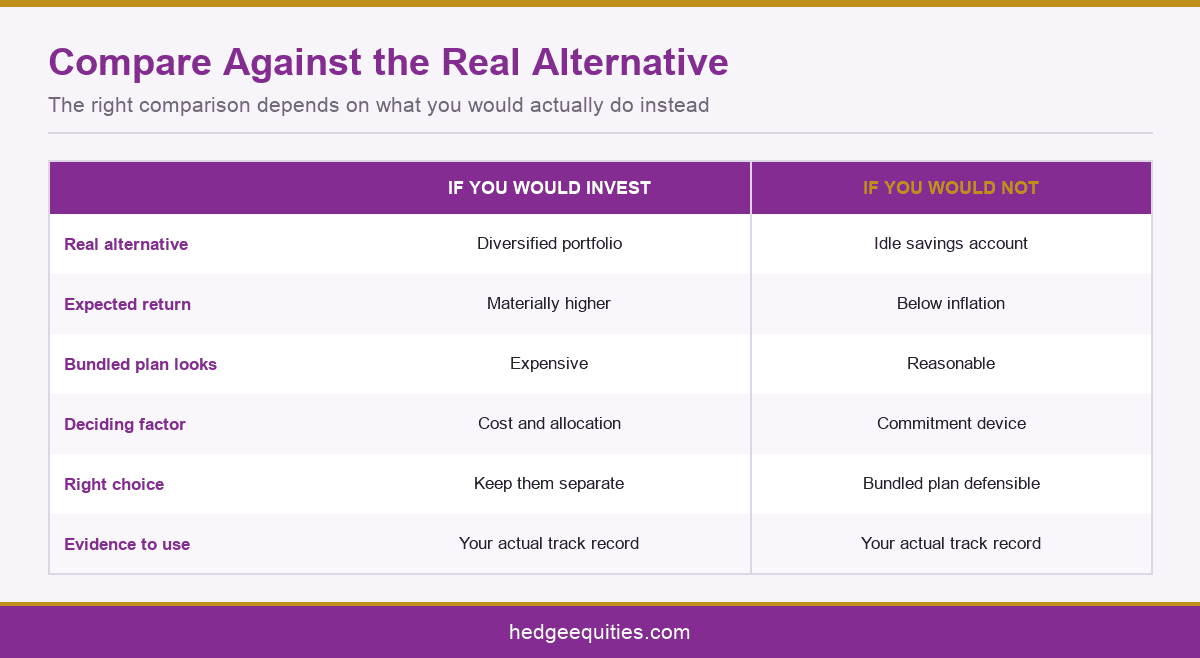
Be careful not to use this profile as a flattering self description. Almost everyone believes they would maintain a monthly investment, and a substantial number do not. The evidence that counts is your own bank statement over the past five years, not your intention for the next twenty. Look at what you actually did before deciding what you would do.
[Alt: Infographic showing three investor profiles where combining life insurance and investment works]
Profile Two: The Investor Buying a Fixed Date Obligation
The second profile is situational rather than behavioural. It applies when a specific sum is required on a specific date and there is no flexibility in either the amount or the timing.
A child's university admission does not move because markets are down. A committed property payment does not wait. Where the obligation is fixed and the date is known, the risk that matters is not underperformance but a bad sequence of returns arriving at precisely the wrong moment.
A guaranteed instrument removes that risk entirely, and the certainty is worth paying for. The cost is real, as we set out in our analysis of what guarantees and lock ins actually cost, but here it buys something specific rather than simply reducing volatility for its own sake.
The strength of this case scales with how close the date is and how rigid the amount is. A fee due in eighteen months with no flexibility is a strong case for certainty. A goal fifteen years out with a range rather than a fixed figure is not, because there is ample time to absorb a poor year and adjust along the way.
Profile Three: The Investor Who Cannot Tolerate Volatility
The third profile is the investor whose genuine risk tolerance is very low, and for whom the realistic alternative is not a balanced portfolio but money left sitting in a savings account.
Risk tolerance is often discussed as though it were a preference to be corrected through education. Sometimes it is. But for some investors it is a settled disposition, and pushing them into equity produces predictable results: they exit at the first substantial fall, crystallising a loss and confirming their view that markets are not for them.
For that investor the relevant comparison is not a bundled plan against a diversified portfolio. It is a bundled plan against idle cash losing purchasing power to inflation year after year. On that comparison, a combined product looks considerably more attractive, and dismissing it as inferior misses the actual alternative.
Test the disposition rather than assuming it. Ask yourself what you would do if the portfolio fell by thirty percent over four months, and be honest about the answer. An investor who would sell has a lower effective risk tolerance than any questionnaire will record, and building a plan on the questionnaire rather than the behaviour reliably ends badly.
There is a middle route worth considering for this profile. A conservative hybrid allocation with limited equity exposure can deliver more than idle cash while remaining calm enough that the investor stays invested. That may serve better than either a bundled policy or a full equity allocation, and it is worth testing before concluding that only a guarantee will do.
[Alt: Infographic comparing a bundled insurance plan against the investor's realistic alternative]
Who Does Not Fit These Profiles
Equally important is recognising when the combined route is being chosen for a reason that does not survive scrutiny. Three arguments come up repeatedly and none of them hold as well as they once did.
The first is tax. Two amendments have narrowed the advantage substantially, removing the exemption on higher premium policies. Anyone recommending a bundled plan primarily for tax reasons should be asked to confirm your position against the current thresholds published by the Income Tax Department rather than the position that applied some years ago.
The second is forced savings for an investor who already saves reliably. The third is the belief that a policy is somehow safer than a regulated mutual fund. Both are regulated, by IRDAI and SEBI respectively, and neither is free of risk. The risks are simply different in character.
A fourth weak argument deserves naming: that a policy enforces discipline on a spouse or a wider family. That may be true, but it is worth asking whether the same result could be achieved with a joint account and an auto debit mandate. Paying policy charges for two decades to solve a problem that a standing instruction also solves is an expensive way to keep the peace.
How to Judge Your Own Case Honestly
Self assessment is the hardest part of this decision, because the questions that matter are about behaviour rather than arithmetic. Three questions get most investors to a clear answer.
Have you previously started and abandoned a voluntary investment? Is the money earmarked for a fixed sum on a fixed date? Would your realistic alternative be a diversified portfolio, or idle cash? A yes to any one of these strengthens the case for a combined product materially.
If all three answers are no, the separate route almost certainly serves you better, and our guide to insurance and investment sets out how to construct it. If you would like an independent view on which profile fits you, our team in Kochi works through exactly this with clients as part of our process.
If you conclude that a bundled product does suit you, buy it deliberately rather than by default. Size the cover to your actual requirement rather than to the premium you were quoted, check the surrender table before signing, and confirm the tax treatment for your issue date. A considered purchase and a sold one can involve the same product and produce very different outcomes.
Whichever route you choose, record the reasoning at the time. Long dated decisions are routinely second guessed years later on the strength of an outcome nobody could have known, and a short note explaining why you decided as you did protects you from revisiting a sound decision simply because markets moved.
Conclusion
Combining life insurance and investment is the wrong default and the right answer for a minority. Those who will not sustain a voluntary investment, who face a fixed obligation on a known date, or whose real alternative is idle cash, are genuinely better served by a bundled product. Everyone else is paying for a commitment device they do not need. Contact Hedge Equities for a view on your own case.
Frequently Asked Questions
Should life insurance and investment be combined?
Usually not. For most Indian investors, term cover plus a separate portfolio delivers more protection and more expected wealth. Combining suits a minority with specific behavioural or certainty needs.
What is the strongest argument for a bundled plan?
That an investor who would not sustain a voluntary investment for twenty years will reliably pay a premium. A modest return actually achieved beats a strong return abandoned early.
Is a bundled plan still good for tax saving?
Less so than before. Exemption thresholds now apply based on policy type, issue date and aggregate annual premium. Confirm your position under current rules rather than assuming the older treatment.
Is an insurance policy safer than a mutual fund?
Neither is free of risk. Insurance is regulated by IRDAI and mutual funds by SEBI. The risks differ in character rather than in magnitude, so the comparison should be about suitability, not safety.
What if I have already bought a bundled plan?
Do not surrender automatically. Compare the surrender value plus the return on redeploying it against continuing to maturity. Early charges are already paid, which sometimes favours continuing.
How do I know if I would actually maintain a SIP?
Look at your own history rather than your intentions. If you have started and abandoned voluntary investments more than once, that is meaningful evidence about how you behave.
Does automation solve the discipline problem?
Largely. An auto debit mandate removes most of the discretion that causes lapses. If you can commit to that, the behavioural argument for bundling weakens considerably.
Are guaranteed plans suitable for a child's education?
They can be, where the sum and the date are both fixed. The certainty removes the risk of markets falling just as fees fall due, which is a real and specific benefit.
What should I ask before buying a combined product?
The internal rate of return on your own premium schedule, the surrender values at years three, five and ten, which portion of the maturity value is contractually guaranteed, and the applicable tax treatment.
Can Hedge Equities advise on which route suits me?
Yes. Assessing which profile fits an investor forms part of our advisory work. See who we serve for the client profiles we work with across Kerala and the Gulf.