
Most searches for the best mutual fund managers lead to a ranked list sorted by trailing returns. That list changes every quarter and tells you almost nothing about whether the person actually running your money today is the same one who earned those returns, or whether the strategy that produced them is still being followed. This guide gives you a framework that survives longer than a single quarter's rankings.
The manager behind a fund matters as much as the fund's fact sheet, and often gets far less scrutiny from investors comparing options.
Key Takeaways
·A strong trailing return is meaningless if the manager who produced it left the fund since then. Always check tenure alongside performance.
·Style drift, a fund quietly investing outside its stated mandate, is one of the least visible risks in mutual fund portfolio management.
·Performance across at least one full market downturn tells you more than performance during a single bull run.
Why Trailing Returns Alone Mislead Investors
A five year annualised return figure blends every market condition the fund experienced over that period into a single number. Two funds can post identical five year returns while one endured a sharp fall and recovered, and the other delivered steady, unremarkable performance throughout. These are very different risk profiles hiding behind the same headline figure, and the difference matters enormously depending on your own tolerance for volatility.
Rankings built purely on trailing returns also reward recent performance disproportionately, since a single strong year can lift an otherwise average five year track record. This creates an incentive for list based comparisons to favour funds that happened to catch a recent rally, rather than funds run with a consistent, repeatable process.
This is not a call to ignore returns entirely. Returns remain the eventual outcome that matters. The point is that returns alone, presented as a single number without context on how they were achieved or by whom, are an incomplete basis for a decision you may hold for a decade or more.
Track Record Across Market Cycles, Not Just Up Markets
The genuinely useful test is how a fund performed during a period most investors would rather forget, such as a sharp correction or an extended sideways market. A fund that fell less than its category average during a downturn, even if it also rose less during the subsequent recovery, may be a better fit for an investor who cannot tolerate large drawdowns without abandoning the plan.
This is where mutual fund portfolio management genuinely earns its fee. Anyone can construct a portfolio that performs well in rising markets. A manager's actual skill, and the value of active management over a passive index, shows up most clearly in how a portfolio is positioned heading into and through a downturn.
A practical way to check this is to compare a fund's calendar year returns against its category average for each of the last several years individually, rather than relying on a single blended figure. A fund that consistently ranks in the upper half of its category most years, without ever being the single best or worst performer, often reflects a more repeatable process than one that alternates between top decile and bottom decile results.
Tenure on the Specific Fund, Not Just at the Fund House
A fund's five year track record belongs to whoever managed it during those five years, not necessarily the person currently listed as fund manager. Manager changes happen regularly across the industry, and a new manager inheriting a strong historical record is not the same as a manager who built that record personally.
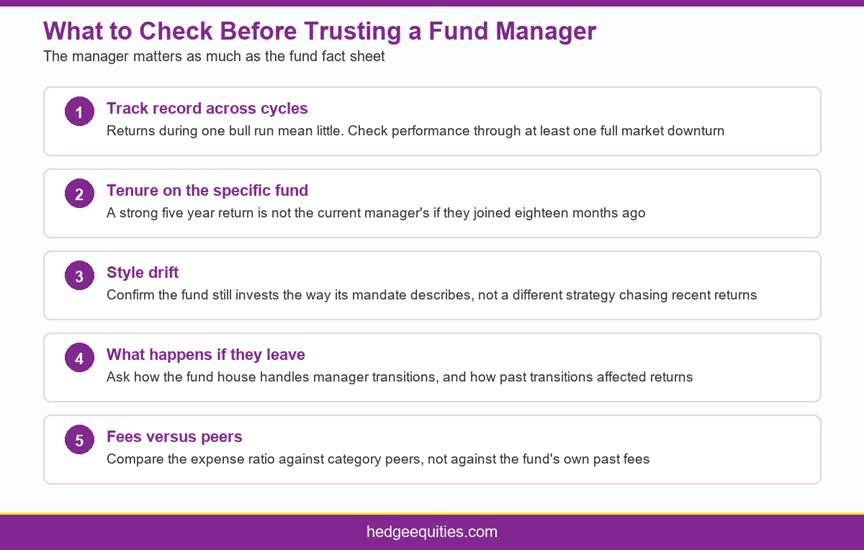
Check the manager's start date on the specific fund, available in every scheme's factsheet, before attributing its historical performance to the person currently in charge. If the tenure is short, ask instead about that manager's track record on whatever fund they managed previously, which is a fairer basis for judgment.
Fund houses are required to disclose manager tenure in the factsheet distributed alongside every scheme, updated at each publication cycle. This is a two minute check that most investors skip entirely, largely because comparison platforms tend to foreground return figures far more prominently than manager tenure, even though the two are inseparable when judging what a historical return figure actually tells you.
Style Drift: When a Fund Stops Doing What It Promised
Style drift occurs when a fund's actual holdings gradually diverge from its stated mandate, often chasing whichever sector or theme has recently outperformed. A large cap fund quietly accumulating mid cap exposure to chase returns is taking on a risk profile investors did not sign up for when they chose a large cap fund specifically for its stability.
This is checkable. Portfolio disclosures, published monthly by every mutual fund, show actual holdings by market capitalisation and sector. Comparing this against the fund's stated mandate periodically is a simple habit that catches drift before it becomes a significant problem.
Style drift is easiest to spot at the extremes, a large cap fund holding a third of its portfolio in mid or small cap names, for example, but subtler drift within a single category is harder to catch without periodically re-reading the actual holdings rather than relying on the fund's category label alone. This is one of the specific checks included in a mutual fund portfolio management review at Hedge Equities.
What Happens If the Manager Leaves
Fund houses handle manager transitions differently. Some maintain a strong internal process and investment committee structure that limits disruption when a single manager departs. Others rely heavily on one individual's judgment, and performance visibly changes after that person leaves. Ask directly, or check how the fund performed after previous manager transitions, before assuming continuity is guaranteed.
This question matters more the longer your investment horizon, since a ten or fifteen year holding period will very likely include at least one manager transition somewhere along the way, regardless of which fund you choose today.
Some fund houses run a committee based process where multiple analysts contribute to decisions under a documented framework, which tends to reduce the disruption from any single departure. Others are genuinely built around one recognised individual's judgment call. Neither structure is automatically better, but knowing which one you are relying on changes how much weight a manager transition should carry in your decision to stay invested or move elsewhere.
Fees Relative to Peers, Not to the Fund's Own History
Compare a fund's expense ratio against its category peers rather than against its own fees from prior years. A fund that has always charged a certain fee is not automatically reasonably priced simply because the fee has not changed. Direct plans, which exclude distributor commission, typically carry a meaningfully lower expense ratio than regular plans for the identical underlying portfolio, and the difference compounds significantly over a long holding period.
Total expense ratio disclosures are published by AMFI, the mutual fund industry body, and by every fund house, and are worth checking directly rather than relying solely on figures quoted by whoever is selling you the fund. A gap of even half a percentage point in annual fees compounds into a meaningful difference in final corpus over a fifteen or twenty year holding period, often larger than the difference between two reasonably well managed funds in the same category.
None of this evaluation needs to happen alone. A financial health checkup at Hedge Equities includes a review of existing mutual fund holdings against these exact criteria, as part of building or refining your broader portfolio management services for small investors strategy.
The best mutual fund managers are not simply the ones sitting at the top of this quarter's return table. They are the ones with a demonstrated process across full market cycles, clear tenure on the fund you are evaluating, no meaningful style drift from their stated mandate, and a fee that holds up against category peers. Get your existing mutual fund holdings reviewed against this framework.
Frequently Asked Questions
How do I find the best mutual fund managers in India?
Look beyond trailing returns to track record across market cycles, tenure on the specific fund, and consistency with the fund's stated mandate, not just a ranked list of recent performance.
Does a fund manager change affect my mutual fund investment?
Yes, potentially significantly. Check how the fund performed after previous manager transitions before assuming continuity, especially for funds heavily reliant on one individual's judgment.
What is style drift in mutual fund portfolio management?
Style drift happens when a fund's actual holdings diverge from its stated mandate, often chasing recent outperformance in a different market segment than the fund was designed to cover.
How often should I review my mutual fund manager's performance?
Annually is reasonable for most investors, alongside a broader portfolio review, rather than reacting to short term quarterly performance swings.
Is a higher expense ratio ever justified for a mutual fund?
Sometimes, if the fund consistently outperforms its category net of fees across full market cycles. Compare fees against category peers, not the fund's own historical fee level.
What is the difference between direct and regular mutual fund plans?
Direct plans exclude distributor commission and carry a lower expense ratio than regular plans for the same underlying portfolio, which compounds meaningfully over a long holding period.
Should I choose a fund based on one year of strong returns?
No. A single strong year can be an outlier. Evaluate performance across at least one full market cycle, including a downturn, before drawing conclusions about manager skill.
How does portfolio management advice differ from picking mutual funds myself?
A SEBI registered advisor evaluates funds against your specific goals and risk tolerance, covered in
What documents show if a fund has style drift?
Monthly portfolio disclosures published by every mutual fund show actual sector and market capitalisation exposure, which you can compare against the fund's stated mandate.
Can Hedge Equities review my existing mutual fund portfolio?
Yes. A financial health checkup includes a review of existing holdings against track record, tenure, and style consistency criteria.