
Most share portfolio management advice assumes an investor building a diversified portfolio from scratch. It rarely addresses a very different and very common situation across Kerala: a business family or a senior employee whose net worth is already overwhelmingly tied to a single company, either through generations of family shareholding or through vested employee stock options. Our earlier guide, Share Market Portfolio Management: A Complete Guide, covers portfolio construction broadly. This article addresses the specific, and specifically difficult, problem of concentration risk that no amount of general share market strategy resolves, because the problem is not which additional stocks to buy, it is what to do about the one holding that already dominates everything.
Key Takeaways
Concentration risk is common and rarely discussed openly in Kerala business families and among senior employees with vested stock.
The risk is compounded when income and investment capital both depend on the same company.
Reducing concentration does not require an abrupt, disruptive sale; it can be phased in a way that respects family and career considerations.
Why Concentration Risk Is So Common Here
A meaningful share of family wealth in Kerala sits in shares of a business the family itself built, sometimes over two or three generations, alongside land and property. This is a natural outcome of how wealth is actually created, not a mistake anyone consciously made. Similarly, a senior employee at a successful company who has accumulated stock options over a decade can find that a single employer's share price now drives a disproportionate share of their entire net worth, again without any single decision that looks wrong in isolation. The trouble is not how the concentration formed. It is that most families and employees never step back to ask what the concentration means for their financial security as a whole, because the holding is wrapped up in identity, loyalty, and history in a way a stranger's stock pick never is. That emotional weight is exactly why concentration risk persists quietly for years in situations where a purely financial analysis would have flagged it immediately. There is also a generational element specific to Kerala worth naming directly. Many family businesses here were built by a founding generation that reinvested almost everything back into the enterprise rather than diversifying personal wealth outside it, a strategy that made sense while actively growing a young business and building the very asset that later generations now hold as concentrated stock. What was a sound growth strategy for a founder actively running the business becomes a very different risk profile for heirs who may hold shares passively, without the same day-to-day influence over the outcome, which is exactly the transition point where concentration risk deserves fresh, deliberate examination rather than simply continuing an inherited assumption.
The Specific Danger of Correlated Income and Capital
Standard portfolio theory worries about a stock falling in value. Concentration risk in a family business or an employee stockholding is worse than that, because a downturn threatens both the investment and the income at the same time. If the family business struggles, the shares lose value and the salary or dividend income the family draws from the business often shrinks in the same period, for the same reason. An employee holding a large block of vested stock in their employer faces an even sharper version of this: a company in genuine trouble is also the company most likely to conduct layoffs, meaning the same event that crashes the stock price can end the salary income simultaneously. This double exposure, where the asset and the income both depend on one underlying business, is the specific feature that makes concentration genuinely dangerous rather than merely undiversified, and it deserves a different response than ordinary portfolio advice provides. This is precisely the pattern behind some of the most painful wealth destruction events in Indian markets: an employee or family holding a large, undiversified stake in a company that later ran into genuine trouble, discovering too late that their emergency fund, their retirement plan, and their monthly income were all quietly dependent on the same underlying business outcome. Diversification exists specifically to prevent one bad event from becoming a total event, and concentrated holdings, almost by definition, remove that protection at exactly the point where it matters most.
Recognising the Warning Signs Honestly
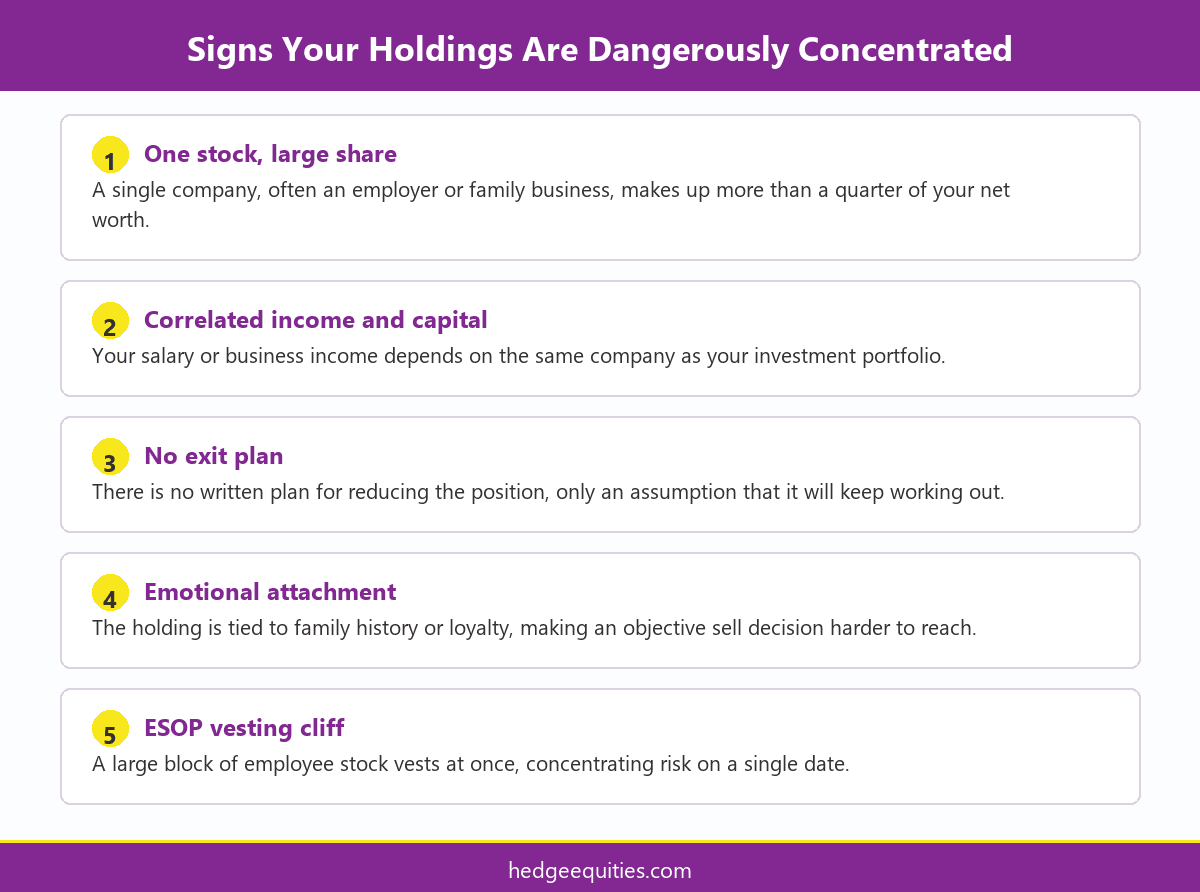
A rough but useful rule is to treat any single holding above roughly a quarter of total net worth as requiring active attention, and to treat it with real urgency once it crosses closer to half. Beyond the raw percentage, watch for compounding warning signs: no written plan for eventually reducing the position, a family culture where even discussing a sale feels disloyal, or an ESOP structure where a large block vests on a single date rather than gradually, concentrating both the tax event and the market-timing risk into one moment. None of these signs mean a family or an employee has done anything wrong. They mean the concentration has reached a point where continuing to leave it unexamined is itself a decision, just an unconscious one, and unconscious decisions about a large share of someone's total wealth deserve to be made deliberately instead. A simple exercise makes this concrete: write down, honestly, what percentage of total household net worth, including property, sits in the single company in question, and then imagine explaining that number to a financial advisor who has never met the family and has no emotional stake in the answer. Most people who complete this exercise honestly find the number higher and the imagined advisor's reaction more concerned than they expected before writing it down.
[Alt: Checklist of warning signs for dangerously concentrated stock holdings] | File: infographic-1-concentration-risk-checklist.png
Reducing Concentration Without Disrupting the Family or the Career
The instinct many advisors default to, sell a large block immediately and diversify, is often precisely wrong for a family business, since a sudden sale can look like a loss of confidence to employees, customers, and lenders, and may simply not be possible if shares are closely held and illiquid. A more workable approach phases the reduction over several years using a fixed, pre-agreed schedule, similar in spirit to a systematic transfer plan, converting a portion of the concentrated holding into a diversified portfolio management services allocation on each anniversary regardless of the current share price, which removes both the emotional difficulty of deciding when to sell and the temptation to keep waiting for a better moment that may never arrive. For employees, the equivalent is a standing plan to sell a fixed percentage of newly vested stock immediately on each vesting date, treating diversification as a default rather than a decision that has to be made afresh every time. The specific percentage and timeline matter less than the existence of a written, pre-committed rule, because a rule decided in advance, during a calm period, removes the need to make a fresh emotional judgment call at the exact moment the stock is performing well and selling feels hardest to justify, or performing badly and selling feels like giving up too easily. Either emotional state produces a worse decision than a plan agreed to in advance and simply followed.
Building a Plan That the Whole Family Can Agree To
Because concentration in a family business touches shared history as much as it touches personal finance, a plan that one member designs alone rarely survives contact with the rest of the family. The more durable approach involves the key stakeholders directly in setting the phased schedule and the target end state, framing the plan explicitly as protecting the family's overall financial security rather than as a vote of no confidence in the business itself. An outside investment and portfolio management advisor can be genuinely useful here specifically because they are not part of the family narrative, and can propose a number and a schedule without carrying any of the emotional history that makes the same proposal difficult for a family member to raise credibly on their own. It also helps to separate the conversation into two distinct questions that families often blur together: how the business itself should be run and grown, which remains entirely a family and management decision, and how much of the family's personal financial security should depend on that single outcome, which is a portfolio question with its own answer regardless of how well the business is performing at any given moment. Keeping these two questions separate tends to make the diversification conversation considerably less threatening to raise and considerably easier to agree on.
Conclusion
Concentrated holdings in a family business or an employer's stock are not a mistake to be corrected overnight, and they are not a problem that generic share portfolio management advice, built for diversified strangers, actually addresses. They are a specific and common situation across Kerala's business families and senior employees that calls for a phased, deliberately designed plan, one that respects the history behind the holding while still protecting the family's broader financial security from a single point of failure. If a significant share of your net worth sits in one company, family owned or otherwise, a conversation about a phased diversification schedule is worth having well before market conditions force the conversation on you. The families who start this conversation early, on their own terms, are in a far stronger position than those who wait for a downturn to make the decision for them.
Frequently Asked Questions
What counts as a concentrated stock holding?
A common guideline treats any single holding above roughly a quarter of total net worth as requiring active attention, with urgency increasing as it approaches half.
Why is family business concentration riskier than an ordinary undiversified stock position?
Because income and investment capital are often correlated: a downturn in the business can reduce both the value of the shares and the income drawn from them at the same time.
How can I reduce concentration risk without selling the family business shares abruptly?
A phased schedule that converts a fixed percentage into diversified holdings on a set timeline, regardless of share price, avoids both market timing risk and the appearance of a loss of confidence.
What should employees do with a large block of vesting ESOPs?
Many advisors recommend selling a fixed percentage of newly vested shares on each vesting date by default, treating diversification as automatic rather than a fresh decision each time.
Is it disloyal to reduce holdings in a family business?
Framing the plan as protecting overall family financial security, rather than as a lack of confidence in the business, usually helps reconcile the decision with family loyalty.
How does an outside advisor help with family concentration risk?
An advisor outside the family narrative can propose a specific number and schedule without carrying the emotional history that makes the same proposal difficult for a family member to raise.
What is the biggest hidden risk of an ESOP vesting cliff?
A large block vesting on a single date concentrates both the tax event and the market-timing risk into one moment, rather than spreading it gradually.
Does portfolio management services help with concentrated single-stock risk?
Yes. A managed mandate can absorb proceeds from a phased reduction and build a diversified allocation systematically, discussed further in our guide to direct stock portfolios, DIY versus managed.
Can concentration risk affect retirement planning?
Yes, significantly, since a retirement plan that depends heavily on one company's share price is exposed to a single point of failure at precisely the time flexibility matters most.
Where should a Kerala business family start addressing concentration risk?
Start with an honest audit of what percentage of total net worth the business shares represent, then work with an advisor on a phased plan, alongside our broader guide to private wealth management for HNI families.