
Every investor who has built a direct equity portfolio eventually asks the same question: is it still worth doing this yourself, or should stock portfolio management companies take it over. Our earlier guide, Share Market Portfolio Management: A Complete Guide, covers the fundamentals of building a direct stock portfolio. This article tackles the harder, more personal question directly: a true accounting of the time, skill, and cost involved in doing it yourself, set against what a managed portfolio management firms relationship actually costs and delivers, so the comparison is based on real numbers rather than a vague sense that hiring help is either always better or always an unnecessary expense. Both positions are common among investors, and both are wrong often enough that neither should be assumed without actually doing the arithmetic first.
Key Takeaways
DIY stock investing has a real time cost that is usually underestimated until it is tracked honestly for a few months.
A managed portfolio's fee should be compared against the value of your time and the cost of behavioural mistakes, not treated as pure overhead.
The right choice often depends on portfolio size and complexity as much as personal preference.
The Real Time Cost of Managing Your Own Stocks
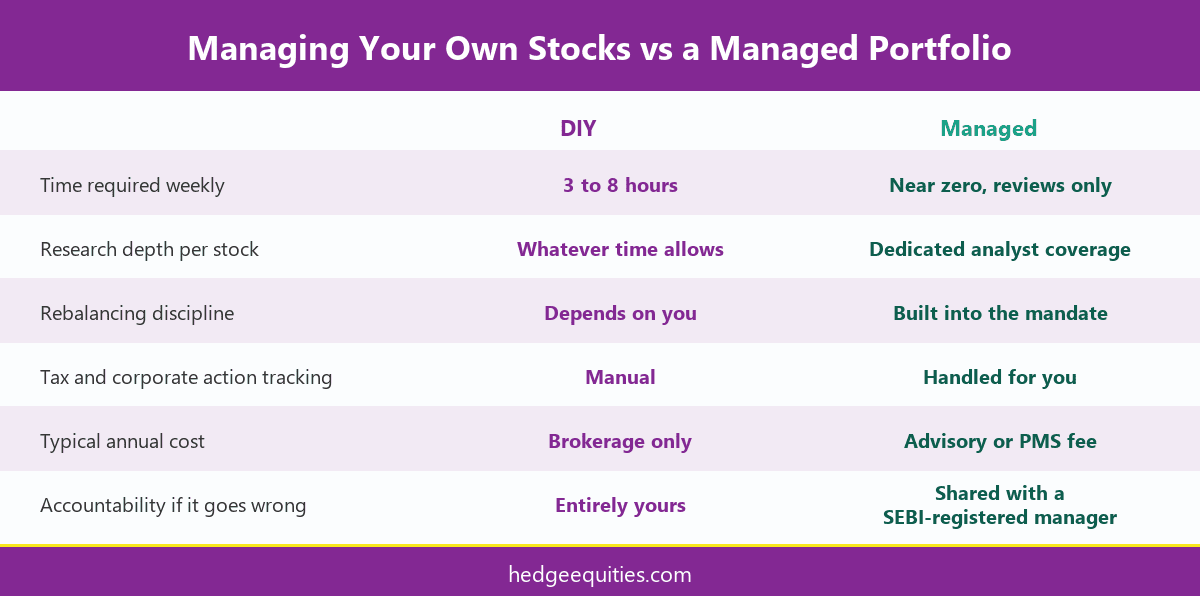
Ask a serious DIY investor to honestly log their hours for a month, and the number is usually higher than they expected going in: reading quarterly results and management commentary for each holding, tracking corporate actions like bonus issues, rights issues and buybacks, following sector and macro news that might affect a position, and periodically reassessing whether the original investment case still holds. For a concentrated portfolio of eight to ten stocks followed properly, this routinely runs to three to eight hours a week, and considerably more around results season when multiple companies report in the same fortnight. That time has a real opportunity cost, whether it is measured against billable hours in a profession, time with family, or simply the mental bandwidth that direct investing quietly consumes even outside the hours actually spent at a screen. Few investors price this time into their decision when they compare a zero-brokerage DIY approach against an advisory fee, but it belongs in the comparison as honestly as any rupee figure. A practical way to see this clearly is to keep a simple log for thirty days: every time you check a stock price out of habit rather than necessity, every time you read a results call transcript, every time you research a new idea that never turns into a position, note the minutes spent. Most investors who run this exercise for the first time are surprised by two things: how much total time accumulates in small increments across a month, and how much of it is reactive checking driven by anxiety rather than productive analysis that actually improves a decision.
What a Managed Firm Is Actually Being Paid to Do
A portfolio management services fee is not simply a charge for picking stocks, since a determined DIY investor can also pick reasonable stocks with enough study. It is a charge for continuous coverage: someone reading every quarterly result the day it is released, tracking corporate actions across the entire portfolio without missing a rights issue deadline, and maintaining the discipline to rebalance on a schedule even when it feels uncomfortable to sell a winner or buy more of a laggard. It is also, critically, a transfer of accountability. When a managed decision goes wrong, there is a SEBI-registered professional whose regulatory standing depends on explaining and correcting the mistake. When a DIY decision goes wrong, the accountability begins and ends with the investor alone, which is a meaningfully different experience during a genuinely difficult market. This coverage also extends to things that are easy to overlook until they are missed: a rights issue deadline that passes unnoticed during a busy work week, a corporate action that changes a holding's cost basis for tax purposes without the investor realising it, or a promoter pledge disclosure buried in an exchange filing that a professional team is set up to catch as a matter of routine process rather than luck. None of these individually is catastrophic, but they compound over years into a meaningfully different outcome between a portfolio that receives this kind of continuous, structured attention and one that does not. Firms are also required to maintain records and audit trails for every decision made on a client's behalf, which creates a layer of documented accountability that a personal spreadsheet, however carefully kept, rarely matches in practice.
Where DIY Genuinely Wins
None of this means DIY investing is the wrong choice by default. An investor with real domain knowledge, someone who understands a specific sector deeply through their own career, for instance, can sometimes out-research a generalist portfolio manager on that narrow slice of the market. DIY also wins decisively on cost for a simple, buy-and-hold portfolio of index funds or a handful of blue-chip stocks held for the very long term with minimal trading, where the ongoing management task is genuinely light. And DIY offers a form of engagement and control that some investors value for its own sake, independent of whether it is the mathematically optimal choice, and that preference is a legitimate factor in the decision, not something to be talked out of. A doctor who invests only in pharmaceutical and healthcare stocks they understand from their own practice, or an engineer who has spent a career inside the infrastructure sector, brings a genuine information advantage that a generalist manager covering the entire market cannot easily replicate on that narrow slice. The honest caveat is that this advantage rarely extends cleanly across a full, diversified portfolio, which is why even investors with real domain expertise often combine a self-managed satellite position in their area of knowledge with a more broadly managed core.
Where a Managed Portfolio Genuinely Wins
A managed relationship tends to earn its fee most clearly in three situations: a portfolio large and complex enough that proper coverage genuinely requires more hours than an individual investor with a full time job can realistically supply, an investor whose own trading history shows a clear pattern of panic selling in downturns or chasing rallies too late, and a portfolio that sits alongside other complicating factors such as an NRI tax situation or a family business shareholding, discussed in our related pieces on online wealth management for Kerala and Gulf-NRI households and concentrated single-stock and family-business risk. In each of these cases, the fee is less a cost of convenience and more a direct substitute for a genuine gap in time, discipline, or specialised knowledge. It is worth being specific about the second situation, since it is the one investors are least likely to recognise in themselves. Pull up your own transaction history over the last two market corrections. If you sold meaningfully during the fall and bought back in only after prices had already recovered, that pattern, repeated, is a quantifiable cost that a managed mandate is specifically designed to prevent, and it is often larger over a decade than any advisory fee charged along the way.
A Fair Way to Run the Comparison Yourself
Track your own hours honestly for one full month, including results season if it falls within that window, and assign them a rate based on what an hour of your time is genuinely worth to you, whether that is a professional billing rate or simply a personal estimate. Add your actual brokerage, demat, and any subscription costs for research tools. Compare that total, in both time and money, against a typical advisory or portfolio management services for small investors fee for a portfolio of your size. The answer is rarely as one-sided as either a committed DIY investor or a committed advisory client tends to assume going in, and running the numbers honestly, just once, is usually enough to reveal which side of that line your own situation actually falls on. Repeat the exercise once a year rather than treating it as a one-time decision, since portfolio size, personal time availability, and career demands all change, and a comparison that favoured DIY five years ago may no longer hold once a portfolio has grown considerably larger or a job has become considerably busier.
Conclusion
There is no universally correct answer between managing your own direct stock portfolio and handing it to a managed firm. What there is, is a fair comparison that most investors never actually run: real hours tracked honestly, real costs on both sides, and an honest look at your own trading discipline through past market cycles. Run that comparison once, using the method above, before assuming either path is obviously right for you. Hedge Equities is glad to walk through what a managed mandate would look like for a portfolio your size, so you can compare it against your own numbers rather than a generic industry claim. That single conversation usually takes less time than the exercise of tracking your own hours honestly for a month, and it gives you a concrete number to weigh against the total you arrive at on your own side of the ledger, so the final decision rests on your own arithmetic rather than on anyone's general opinion, ours included.
Frequently Asked Questions
Is it cheaper to manage my own stock portfolio than hire a PMS?
In pure fee terms yes, but the comparison should include the value of your own time and the cost of any past behavioural mistakes, not brokerage alone.
How many hours does managing a direct stock portfolio actually take?
For a concentrated portfolio of eight to ten stocks followed properly, three to eight hours a week is typical, rising sharply during quarterly results season.
When does a managed portfolio make more sense than DIY investing?
When the portfolio is large or complex, when past trading history shows panic-selling or late chasing, or when the situation includes NRI tax or family-business factors.
Can a DIY investor outperform a professional portfolio manager?
In specific cases, particularly where the investor has genuine domain expertise in a narrow sector, yes. On average across a full market cycle, disciplined process tends to matter more than stock-picking skill alone.
What does a stock portfolio management company actually charge for?
Continuous coverage: tracking results, corporate actions, and rebalancing discipline, plus accountability, since a SEBI-registered manager is answerable for the decisions made.
Is DIY stock investing riskier than a managed portfolio?
Not inherently, but it removes a layer of professional discipline and accountability, which matters most during volatile periods when behavioural mistakes are most likely.
How do I compare DIY costs against a managed portfolio fairly?
Track your own hours for a month, value that time honestly, add actual costs, and compare the total against a typical advisory or PMS fee for a similar portfolio size.
Does portfolio size affect the DIY versus managed decision?
Yes. Larger, more complex portfolios generally benefit more from managed coverage, while very small or simple portfolios may not justify the fee, discussed further in our guide to portfolio management below the fifty lakh minimum.
What is the biggest behavioural risk in DIY stock investing?
Panic-selling during downturns and chasing rallies too late, both timing errors that a managed mandate is specifically structured to reduce.
Should first-time investors manage their own stocks?
Many benefit from starting small and simple before deciding, an approach covered in our broader guide on managed investing for small and first-time investors.