
Most explanations of investment analysis and portfolio management stop at why analysis matters, without ever opening the process itself. Our earlier piece, The Importance of Portfolio Analysis for Investors, made the case for why disciplined analysis beats guesswork. This article goes further and documents the actual methodology: how a stock is screened before it is even considered, how it is valued once it passes screening, and how the resulting position is sized inside a live portfolio. The goal is to remove the mystery from a process that is often described in marketing language but rarely shown in working detail, so that an investor evaluating a portfolio manager knows exactly which questions to ask and what a genuinely rigorous answer should sound like.
Key Takeaways
Screening filters the investable universe on quality and governance before valuation work ever begins.
Valuation in a disciplined process rests on cash flow and margin of safety, not on trailing price multiples alone.
Position sizing is a deliberate risk decision bound by mandate limits, not an equal split across chosen names.
Screening: Narrowing the Universe Before Valuation Begins
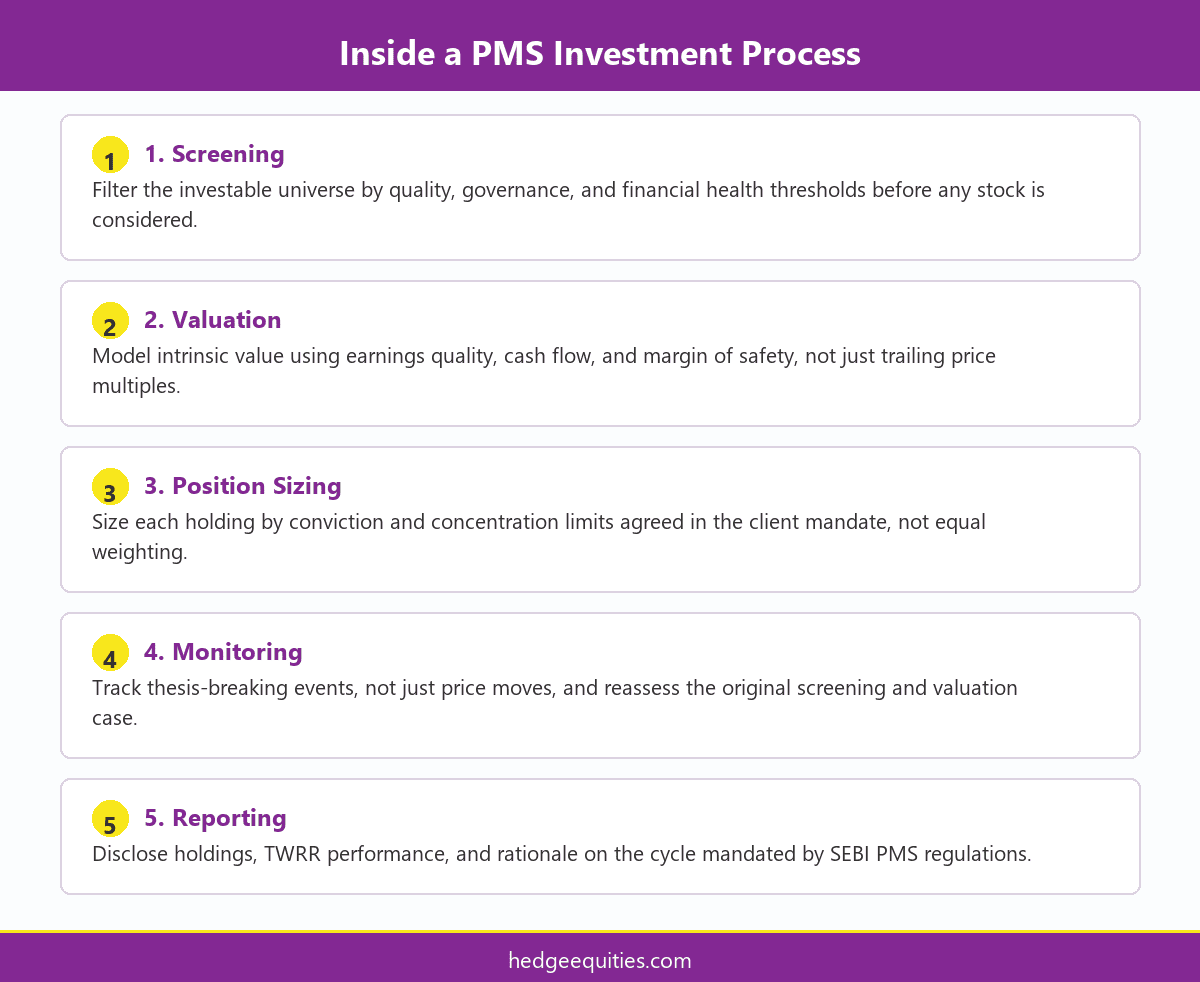
The Indian listed market has more than five thousand companies, and no analyst team can research all of them with equal depth. A disciplined process therefore starts by narrowing the universe using hard filters: minimum market capitalisation and liquidity so positions can be built and exited without excessive market impact, a governance screen that checks promoter shareholding stability, related-party transaction history, and auditor changes, and a financial health screen covering debt levels, interest coverage, and consistency of operating cash flow against reported profit. Companies that fail governance or financial health screens are excluded regardless of how attractive their growth story sounds, because a process that skips this step ends up doing valuation work on companies that were never going to survive a downturn. Only names that clear every filter move forward to the far more time-intensive valuation stage, which is what makes the screening step a genuine efficiency tool rather than a formality. A well-designed screen also encodes lessons from past mistakes across the industry, not just abstract theory: recurring related-party transactions, sudden auditor resignations, and pledged promoter shareholding have preceded a disproportionate share of the corporate governance failures Indian investors have seen over the past decade. Building these specific checks into the screening stage means a process does not have to relearn the same lesson through a client's capital every time a new failure pattern appears in the market. The screen is tightened as new patterns are observed, which makes it a living part of the process rather than a fixed checklist written once and never revisited.
[Alt: Five-stage PMS investment process: screening, valuation, position sizing, monitoring, reporting] | File: infographic-1-pms-investment-process.png
Valuation: Beyond the Price-to-Earnings Ratio
A common shortcut in retail investing is comparing price-to-earnings ratios across companies and calling the lower one cheap. A disciplined valuation process treats that ratio as a starting question, not an answer. It builds a cash flow based model that asks what the business is likely to generate over the next five to seven years, discounts that back to a present value, and compares the result to the current market price to establish a margin of safety, the gap between what you are paying and what the business is conservatively estimated to be worth. Earnings quality matters as much as the earnings number itself: two companies reporting the same profit can differ sharply in how much of that profit converts to real cash, and a process that ignores this difference will systematically overvalue the company with weaker cash conversion. This is also where financial portfolio management diverges most visibly from a purely algorithmic screen, because judgment about the durability of a business's competitive position cannot be fully reduced to a spreadsheet formula. A useful discipline here is scenario testing the valuation model under a slower growth assumption and a higher discount rate than the base case, and checking whether the margin of safety still holds. A stock that only looks attractive under the single most optimistic set of assumptions is not offering a genuine margin of safety, it is offering a story that depends on everything going right, which is precisely the condition a disciplined valuation process is designed to catch before capital is committed rather than after.
Position Sizing: Turning Conviction Into a Number
Passing screening and looking attractive on valuation does not automatically earn a stock a large position. Position sizing translates conviction and risk into a specific percentage of the portfolio, bound by concentration limits agreed in the client mandate: for example, no single stock exceeding a set percentage of the portfolio, and no single sector exceeding a wider cap. A high-conviction idea with strong valuation support might still start as a smaller position if the company is thinly traded or if the broader portfolio already carries meaningful exposure to the same sector. This is a deliberate risk management decision, not an oversight. Equal-weighting every holding, by contrast, is not a sizing strategy at all, but an absence of one, since it applies the same conviction and the same risk tolerance to every idea regardless of how different the underlying analysis actually says they are. Sizing decisions are also revisited over time, not set once at purchase and left unchanged. A position that has grown well beyond its original allocation purely because the price has risen sharply may be trimmed back to the mandate limit even if the thesis is still fully intact, simply to keep the overall portfolio's risk profile within the agreed boundaries. This is a discipline retail investors frequently skip, letting a single winning position grow into an outsized share of the portfolio by default rather than by deliberate choice, which quietly changes the risk profile of the whole portfolio without anyone having decided that it should.
Monitoring: Watching the Thesis, Not Just the Price
A stock's price moving against a position is not, by itself, a reason to sell or hold. What matters is whether the specific reasons the position was built, the thesis, are still intact. A disciplined process tracks thesis-breaking events explicitly: a change in promoter shareholding, a miss against the cash flow assumptions used in the original valuation, or a shift in competitive dynamics that undermines the durability assumption made at entry. When a thesis breaks, the position is reassessed on its own merits, independent of whether the price has already fallen or is still holding up, because price alone lags the underlying business reality and is a poor early warning signal on its own. This distinction is what separates disciplined holding from stubbornness. Continuing to hold a stock through a price fall because the original thesis remains intact is a defensible, deliberate choice. Continuing to hold simply because selling would mean admitting a mistake is a behavioural error dressed up as conviction, and a written monitoring checklist reviewed on a fixed schedule is one of the more effective ways a process guards against confusing the two in the moment.
Reporting: What SEBI Requires and Why It Matters to You
Every stage of this process ultimately has to be reported back to the client in a form that is comparable and auditable. SEBI PMS regulations mandate Time-Weighted Rate of Return, TWRR, reporting specifically because it strips out the distorting effect of when a client added or withdrew money, which a simple absolute-return number does not. A portfolio manager who cannot produce a clean TWRR statement on request, or who reports performance in a format that makes comparison across periods difficult, is giving you a strong signal about how rigorous the underlying process actually is. Reading this report correctly, and asking for the screening and valuation rationale behind specific holdings, is one of the most useful things an investor can do to verify that a stated process matches what is actually happening. Reporting frequency and format are worth checking as carefully as the numbers themselves: a manager providing granular, holding-level detail every quarter is operating under a different level of accountability than one offering only a summary once a year, and that difference should factor into your choice of manager as much as any single performance figure does. Beyond TWRR, a complete report typically includes attribution: which holdings contributed most to gains or losses over the period, and whether that outcome matched what the screening and valuation thesis for those specific names had predicted. When the two line up consistently over several reporting cycles, it is a meaningful signal that the process described to you on day one is the same process actually driving decisions, rather than a description that existed mainly for the sales conversation.
Conclusion
A PMS investment process is not a black box, even though it is often described as one. Screening narrows the field on quality and governance, valuation prices what survives that filter using cash flow rather than shortcuts, position sizing turns conviction into a disciplined number bound by mandate limits, and monitoring watches the thesis rather than the price alone. Ask any prospective portfolio manager to walk you through these five stages specifically for a recent holding. A clear, specific answer at every stage is a far better signal of process quality than a track record chart alone, and it is exactly the kind of scrutiny our own PMS process is built to withstand.
Frequently Asked Questions
What is the first step in a PMS investment process?
Screening. The investable universe is narrowed using quality, governance, liquidity, and financial health filters before any valuation work begins on individual companies.
How is a stock valued inside a professional portfolio management process?
Primarily through cash flow based models that estimate intrinsic value and compare it to market price, establishing a margin of safety rather than relying on price multiples alone.
What does position sizing mean in portfolio management?
It is the decision of how much of the portfolio to allocate to a specific holding, based on conviction and risk, bound by concentration limits set in the client mandate.
Why does SEBI require TWRR reporting for PMS?
Time-Weighted Rate of Return removes the distortion caused by the timing of client deposits and withdrawals, giving an accurate measure of the manager's actual investment performance.
What is a thesis-breaking event in stock monitoring?
A development, such as a governance issue or a cash flow miss, that undermines the original reason a stock was bought, prompting a fresh reassessment independent of price movement.
How many stocks does a typical PMS portfolio hold?
It varies by mandate, but concentrated approaches often hold between fifteen and thirty stocks, reflecting genuine conviction rather than diversification for its own sake.
Is equal weighting a valid position sizing strategy?
Not in a disciplined process. Equal weighting ignores differences in conviction, valuation support, and risk across holdings, which is the opposite of deliberate sizing.
What should I ask a portfolio manager about their investment process?
Ask for a walkthrough of screening, valuation, and sizing for one specific recent holding, and compare the answer against the general claims made in their PMS service provider vetting checklist.
Does a strong past track record prove a good investment process?
Not on its own. A track record can reflect a favourable market cycle as easily as a sound process, which is why examining the methodology directly matters.
How does Hedge Equities structure its PMS investment process?
It follows the same disciplined sequence of screening, valuation, position sizing, monitoring, and reporting described in this article, applied consistently across the private wealth management mandate.