
Women in Kerala live longer, often take career breaks to raise children or care for parents, and many manage the household budget every month. Yet investment planning for women is still treated as an afterthought, folded into a husband's or father's plan instead of built around a woman's own goals.
At Hedge Equities, we work with working women, homemakers, entrepreneurs and women rebuilding after a loss. This guide explains why women need their own plan, how to build a safety net first, and how to keep wealth growing at every stage of life.
Key Takeaways
·Women in Kerala live about six years longer than men, so their savings must last longer.
·A strong plan starts with an emergency fund, health insurance and term cover before investments.
·Investment planning for women works best when investments, nominees and records stay in a woman's own name and control.
Why Investment Planning for Women Needs Its Own Approach
The numbers make a clear case. Investment planning for women has to cover a longer life, more breaks in income and bigger caregiving costs. A plan copied from a male earner's needs often falls short on all three counts.
Kerala women have the highest life expectancy at birth in India, at 78.7 years, against 72.5 years for Kerala men, according to the SRS Abridged Life Tables 2020 to 2024 released in 2026. At age 60, a Kerala woman can expect about 21.9 more years of life. That is a long retirement to fund, often alone in the later years.
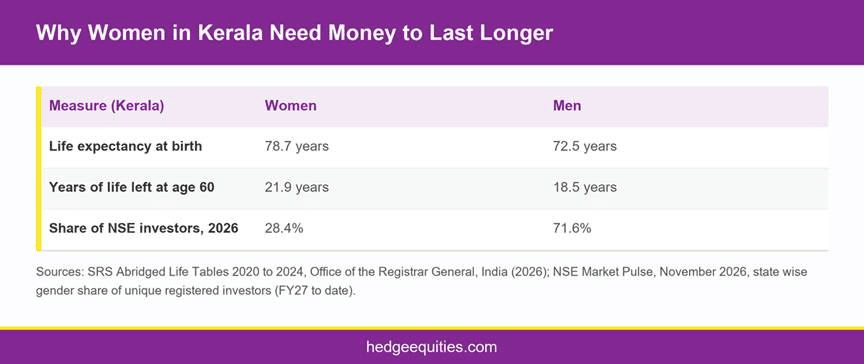
The good news is that women investors in Kerala are already ahead. Women make up 28.4% of unique registered investors from Kerala, above the national figure of 25.2%, according to NSE Market Pulse for November 2026. The next step is turning that interest into a full plan.
Career breaks add to the challenge of investment planning for women. A few years away from work to raise children or care for parents means fewer years of savings and slower growth, so the years you do invest need to work harder. If you are not sure where your own plan stands, our team can help you review it.
Build Your Safety Net Before You Invest
Investing without protection is like building a house without a foundation. Before choosing funds or stocks, every woman needs her own emergency fund, her own health cover and, if others depend on her, term life cover.
Keep several months of expenses in a savings account or liquid fund that you can reach on your own, not only through a joint account. Hold a health insurance policy that covers you even if you change jobs or a family policy lapses. Medical bills are one of the most common reasons savings run dry.
If children or parents depend on your income, add term life insurance sized to their needs. This matters for working women and entrepreneurs alike, because a family often relies on two incomes today, not one.
Homemakers need protection too. The unpaid work of running a home has real value, and replacing childcare or elder care costs money if something happens. Investment planning for women should count that value, not ignore it.
A yearly financial health check up is a simple way to test whether this foundation is still strong.
Questions Women Investors in Kerala Often Ask
Can a homemaker invest in a SIP?
Yes. A homemaker can open a demat or mutual fund account with her own PAN, KYC and bank account, and start a SIP from a small monthly amount, even without a salary. Money received as a gift from a spouse can be invested, though income on it may be added to the spouse's income for tax. Hedge Equities offers workshops and personal coaching for women who want to start investing with confidence.
Is the Mahila Samman Savings Certificate still open?
No. The Department of Posts stopped accepting new deposits in the Mahila Samman Savings Certificate after 31 March 2025, though existing certificates run to maturity. Women who liked its safety can look at other small savings schemes, bank deposits or short term debt funds, keeping in mind that each one is taxed differently. Hedge Equities advisors compare these options against each client's goals and time horizon before recommending a mix.
How should a widow invest a lump sum?
Start slowly. Park the money safely for a few months, settle claims and transfers, and list monthly expenses before committing to anything long term. Then split it between an income portion for the next few years and a growth portion for later life. Hedge Equities advisors support women through loss and life changes, helping them make calm, informed decisions at a difficult time.
Growing Wealth Through Every Life Stage
Good investment planning for women changes with each stage of life. Early in a career, time is the biggest asset. Later, the focus moves to children's goals, then to building a retirement income that lasts.
In your twenties and thirties, start a systematic investment plan and raise it with every salary rise. A SIP for homemakers works the same way, funded from household savings or a regular amount set aside each month. Even ₹2,000 a month, started early, can build a meaningful sum over twenty years.
Women are already a large part of the mutual fund market. They made up 26.3% of unique individual mutual fund investors in December 2025, and 34.6% of individual investor assets, according to the AMFI and Crisil women investors report.
If you have a daughter under 10, the Sukanya Samriddhi Yojana pays 8.2% a year for October to December 2026, with deposits of ₹250 to ₹1.5 lakh a year. In your forties and fifties, investment planning for women shifts toward protecting what you have built. Review your asset mix every year, reduce risk slowly as retirement nears, and plan an income that can last two decades or more.