
Most articles on portfolio management in private equity lead with the return story: the outsized gains a pre-IPO allocation or a private credit fund can generate. This one leads with the exit problem instead, because that is the question an HNI investor should actually answer first.
By the end of this guide you should be able to size a private equity or unlisted allocation correctly against your own liquidity needs, rather than against a manager's fee incentive.
Key Takeaways
AIFs and unlisted shares typically lock up capital for years with little or no secondary liquidity.
SEBI's AIF Regulations define three fund categories, each with a different risk and structuring profile.
Size private equity and unlisted allocations against money you will not need on a fixed date, not against your whole portfolio.
The Exit Problem Comes Before the Return Story
Listed equity can be sold within a trading session, subject to market conditions. Private equity, unlisted shares and most AIF structures cannot. A typical AIF has a defined fund life, often several years, with capital effectively locked until the fund begins returning capital to investors through exits of its own underlying holdings. Unlisted shares held directly may have no ready buyer at all until a liquidity event such as an IPO or acquisition occurs.
This means the first question for any HNI investor is not 'what return might this generate' but 'when do I actually get this money back, and what happens if I need it sooner.' Providers who lead only with the return story are skipping the more important conversation.
It is worth asking a provider directly for the fund's historical distribution timeline on past vintages, not just the projected return of the current fund. A manager with a track record of returning capital roughly on schedule is a different proposition from one whose past funds have consistently run years beyond their stated term.
How AIF Categories Differ
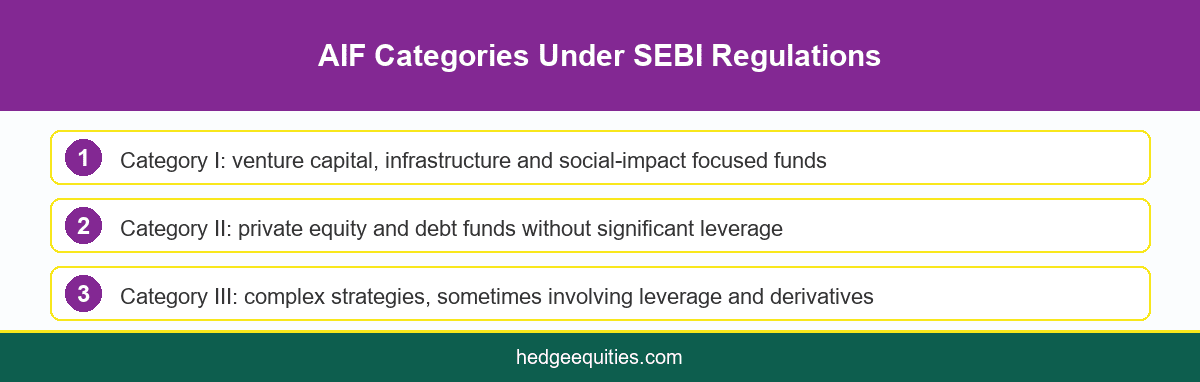
SEBI's Alternative Investment Fund Regulations define three categories. Category I funds generally invest in venture capital, infrastructure or social-impact focused businesses considered to have positive spillover effects on the economy. Category II funds, the largest category by assets, invest in private equity or debt strategies without significant leverage or complex structuring. Category III funds use more complex strategies, which can include leverage and derivatives, and often carry the shortest typical holding period among the three, though still generally longer than listed equity.
Minimum investment thresholds for AIFs are set considerably higher than PMS, and specific figures should always be confirmed against the current SEBI regulations and the fund's own offer document rather than assumed from older figures.
The category also affects taxation treatment, which differs meaningfully between categories and can change with each year's finance act. This is an area where generic online guidance ages quickly, and a current conversation with a tax advisor alongside your portfolio manager is worth the extra step before committing capital to any specific category.
Unlisted Shares: A Different Liquidity Problem Again
Direct unlisted share investments, sometimes offered to HNI clients ahead of an anticipated IPO, carry their own version of the liquidity problem. Unlike an AIF, there is no fund structure managing an eventual exit on your behalf. You are holding shares in a private company with no public market, and your ability to sell depends entirely on finding a buyer, often at a discount, or waiting for the company to list or be acquired.
Valuation is a related issue: unlisted shares are typically valued infrequently and at the discretion of the holder or a limited secondary market, which can make portfolio reporting for this sleeve less precise than for listed holdings. Ask your provider how these holdings are valued between funding rounds, and whether that valuation methodology is disclosed in your periodic portfolio report.
Sizing Private Equity and Unlisted Allocations Correctly
The practical rule for a Kerala business family or Gulf-NRI HNI is straightforward: size private equity, AIF and unlisted allocations against capital you genuinely will not need on a fixed date, not against your total investable wealth. A manager who structures a large share of your portfolio into illiquid sleeves is optimising for their own fee arrangement on those products, not necessarily for your liquidity needs.
This sizing decision should be documented explicitly in your mandate, alongside the other negotiated terms covered in our guide to bespoke PMS mandates. If you already carry concentration risk through a family business, see also our guide to concentrated single-stock and family-business holdings, since adding illiquid private equity on top of an existing concentrated position compounds rather than reduces overall portfolio risk.
A practical starting discipline many advisors use is to stress-test the household's liquid, listed holdings alone against two or three years of expected cash needs before committing any further capital to illiquid sleeves. If the liquid portion alone cannot cover that window comfortably, that is a signal to slow down the private equity allocation, regardless of how attractive the specific opportunity looks.
Questions to Ask Before Committing Capital
Before signing into any AIF or unlisted opportunity, ask for the fund's SEBI registration category and number, the stated fund life and any extension provisions, the fee and carry structure including how carry is calculated on exit, and a clear statement of how and when your capital is expected to be called and returned.
Also ask what has actually happened with the manager's previous funds of the same category and vintage, not just the fund currently being raised. Realised exits from a prior fund tell you far more about a manager's actual execution than the return projections in a current fundraising deck, which are by definition unproven.
Finally, confirm in writing what recourse, if any, exists if the fund's actual life extends significantly beyond its stated term, which is common in private equity and venture structures globally. Understanding this before committing capital avoids an unpleasant surprise years into the investment.
How Private Equity Fits Alongside Your Listed Portfolio
Private equity and AIF allocations should be thought of as a satellite around a listed-portfolio core, not a replacement for it. The listed core, managed under your PMS mandate, provides the liquidity, transparent daily pricing and flexibility that the illiquid satellite structurally cannot. Trying to run these two roles in reverse, treating illiquid private equity as the dependable core, is a common and avoidable mistake among first-time HNI investors drawn in by strong headline return projections.
A reasonable way to think about pacing is to commit to private equity and AIF allocations gradually over several years rather than in one large tranche, a practice sometimes called vintage diversification. This spreads your exposure across different market entry points and fund vintages, reducing the risk that a single poorly timed commitment dominates your illiquid allocation's overall outcome.
Review your combined liquid and illiquid allocation at least annually alongside your portfolio manager, explicitly checking whether your near-term liquidity needs have changed since the last review. A family anticipating a large expense, a business investment, a property purchase, a change in dependents, should factor that into how much further illiquid commitment makes sense in the year ahead.
Tax and Reporting Considerations Worth Raising Early
AIF and unlisted holdings typically generate more complex tax reporting than listed equity, since gains, losses and pass-through income can be characterised differently depending on the fund category and structure. Raise this with both your portfolio manager and a tax advisor before committing capital, not at filing time the following year, since some structuring decisions are easier to plan for in advance than to correct after the fact.
Ask your provider whether they issue the tax statements and pass-through certificates you will need for filing directly, or whether this is left to the fund's own administrator, and how long after each financial year-end these documents are typically available. For a Gulf-NRI investor also managing tax residency questions across two jurisdictions, this timeline can matter as much as the investment decision itself.
Keep a simple running record of every commitment, capital call and distribution across your AIF and unlisted holdings, separate from your PMS statements. Because these instruments do not report on the same continuous cycle as listed equity, a consolidated personal record is often the only place where the true picture of your illiquid exposure and its actual cash flows lives in one place.
Review this consolidated record with your advisor at the same time as your annual mandate review, rather than treating illiquid holdings as a separate, occasional conversation. Bringing the liquid and illiquid pictures together in one sitting is usually what surfaces a liquidity mismatch early enough to actually do something about it.
Conclusion
Private equity and unlisted shares can play a legitimate role in an HNI portfolio, but only once the liquidity question is answered honestly: when does this capital come back, and what is your plan if you need it earlier than expected. Ask that question before the return projection. Hedge Equities' Portfolio Management Services team can help size these allocations correctly against your actual liquidity needs.
Investments in securities market are subject to market risks. Read all the related documents carefully before investing. Hedge Equities Ltd is registered with SEBI as a Portfolio Manager (PMS-INP000003476) and a Research Analyst (RA-INH000004398). This article is for general educational purposes and does not constitute personalised investment advice.
Frequently Asked Questions
What is the minimum investment in an AIF in India?
SEBI's AIF Regulations set a considerably higher minimum than PMS, generally around ₹1 crore for most investors. Always confirm the current figure directly with the fund's offer document.
How liquid are private equity investments in India?
Very illiquid compared to listed equity. Most AIF and private equity structures lock capital for several years with little or no secondary market for early exit.
What are the three categories of AIFs under SEBI rules?
Category I covers venture capital and infrastructure-focused funds, Category II covers private equity and debt funds without significant leverage, and Category III covers more complex strategies, sometimes involving leverage.
Can I sell unlisted shares before a company lists publicly?
Only if you find a private buyer, often at a discount, since there is no public market. Liquidity depends heavily on the specific company and investor demand at that time.
How much of my portfolio should go into private equity or AIFs?
Size these allocations against capital you will not need on a fixed date, not against your total portfolio. A wealth manager should document this sizing decision explicitly in your mandate.
Are AIF returns guaranteed?
No. Like all SEBI-regulated investment products, AIFs cannot guarantee returns, and private equity strategies in particular carry meaningful risk of loss.
What happens if I need to exit an AIF early?
Most AIFs offer limited or no early redemption. Some structures permit a secondary sale of your fund units to another investor, typically at a negotiated discount, but this is not guaranteed.
How is unlisted share valuation different from listed shares?
Unlisted shares are valued infrequently, often based on the last funding round or a limited secondary transaction, rather than a continuous public market price.
Should HNI investors with a concentrated business holding add private equity too?
This can compound risk rather than reduce it. See our guide on concentrated single-stock and family-business risk before adding further illiquid exposure.
How do I evaluate a private equity fund manager before investing?
Request the fund's SEBI AIF registration details, past fund performance and exit track record, and a clear explanation of the
fee and carry structure before committing capital.