
Hedge Equities' own service pages, like most firms in this space, use wealth and asset management services almost interchangeably in places. They are not the same thing, and knowing the difference helps you ask for the right service instead of the one that happens to be marketed loudest.
This guide separates the two definitions clearly, then walks through which one actually fits different investor situations, including the common case where you need elements of both.
Key Takeaways
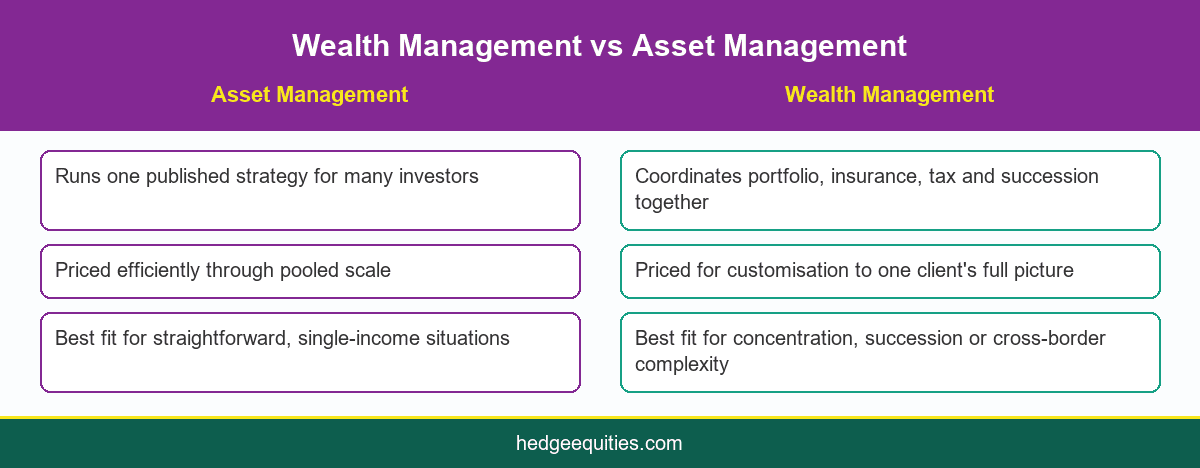
Asset management runs a pooled strategy applied to many investors at once, most commonly through mutual funds.
Wealth management looks at your entire financial picture, insurance, tax, succession, and portfolio, together.
Most investors need elements of both, sequenced correctly rather than chosen as an either-or.
Asset Management: Running Money Against a Strategy
Asset management, in its narrowest and most common sense, means managing a pool of capital, often a mutual fund scheme, against a defined investment strategy and objective. Every investor in that scheme receives the same underlying strategy, scaled to their investment amount. It is efficient, transparent through published NAVs, and regulated under mutual fund and, at larger scale, PMS frameworks.
The strength of asset management is standardisation: costs are lower because the strategy is shared across many investors, and performance is easy to compare against a published benchmark. The limitation is exactly the same thing: the strategy does not bend to your specific tax situation, your family's succession picture, or a concentrated holding you already carry elsewhere.
Asset management providers range from large national mutual fund houses to individual PMS strategies, but the defining feature stays constant: the strategy exists first, and clients opt into it, rather than the strategy being built around one client's constraints.
Wealth Management: Looking at the Whole Picture, Not Just the Portfolio
Wealth management is broader by design. It typically includes portfolio construction, but also insurance adequacy, tax planning, retirement income sequencing, and increasingly, succession and estate considerations. A wealth manager's job is to make sure these pieces work together rather than pulling against each other, for instance ensuring a client is not over-insured in a way that starves the investment portfolio, or under-insured in a way that forces an early portfolio liquidation if something goes wrong.
This is also where the distinction between a private portfolio management mandate and a standard asset management product becomes practically important: a wealth management relationship is far more likely to negotiate portfolio terms specifically because it is already looking at your whole financial situation, not just a pooled strategy.
A good wealth management relationship also revisits its own recommendations over time. A financial plan built five years ago for a client with young children looks different once those children are approaching university age, or once a family business ownership structure has changed. Asset management, by contrast, typically does not revisit anything beyond the fund's own stated strategy.
Which One Do You Actually Need?
If your situation is straightforward, a stable single income, no major concentration risk, no complex succession picture, standardised asset management through mutual funds or a standard PMS strategy is often the more cost-efficient answer. If you carry a concentrated business holding, manage cross-border income as a Gulf NRI, or are approaching a stage where insurance, tax and succession planning all interact with your portfolio, wealth management is the more appropriate frame, even if it costs more.
In practice, most Hedge Equities clients use both: an asset-management layer for straightforward, liquid allocations, wrapped inside a wealth-management relationship that handles the harder questions around concentration, succession and tax. Start with a Financial Health Checkup to establish which layer you actually need before committing to either.
A useful way to test which category you fall into is to list every financial decision you have made in the last year, insurance renewal, a new investment, a family gifting decision, a tax filing choice, and ask whether those decisions were made in coordination with each other or independently. If they were made independently and it worked fine, asset management alone may be sufficient. If gaps or contradictions between decisions have caused real problems, that is a signal you need the coordinated view wealth management provides.
A Practical Example: The Same Investor, Two Different Services
Consider two investors with an identical ₹2 crore portfolio. The first is a salaried professional nearing retirement with no dependents, a paid-off home, and a single, simple succession picture. Standardised asset management, a well-chosen mix of mutual funds or a single PMS strategy, is likely sufficient, since there is little in their situation that a pooled strategy cannot accommodate.
The second holds the same ₹2 crore, but a third of it sits in shares of a family business, they are the primary earner supporting ageing parents and two children, and they hold property jointly with siblings under an informal family understanding. For this investor, the portfolio decision cannot be separated from the concentration, insurance and succession questions running alongside it, which is exactly the coordinated view wealth management is built to provide.
Same portfolio size, same market exposure available to both, but a materially different service need. This is why portfolio value alone is a poor proxy for which service to choose, and why the honest first conversation with any advisor should be about your situation, not your account size.
How the Two Are Priced, and Why That Matters
Asset management pricing is usually a single, published expense ratio or PMS fee, easy to compare across providers because it applies uniformly. Wealth management pricing is more varied: some firms charge a percentage of assets under advice that covers the whole relationship, others charge separately for planning work and portfolio management, and some blend a retainer with transaction-linked fees on specific products.
Ask any wealth management provider to itemise exactly what is covered under their quoted fee and what would trigger an additional charge, for instance a detailed succession planning exercise or coordination with an external tax advisor. Without this breakdown, comparing two wealth management quotes on price alone is not meaningful, since the scope of work behind each number can differ substantially.
This is also a fair question to raise directly with any provider offering both services: ask them to show, in writing, what changes about your relationship and your cost if you move from a pure asset management arrangement into a full wealth management one. A transparent provider should be able to answer this without hesitation.
Signs You Have Outgrown Pure Asset Management
A handful of concrete signals suggest an investor has outgrown a pure asset management relationship. The first is holding meaningfully concentrated wealth in a single business, property or stock position that sits entirely outside any advisor's field of view. The second is a life event, a business sale, an inheritance, a move abroad or back, that changes your tax residency or liquidity picture faster than an annual mutual fund statement can reflect.
A third signal is simply complexity fatigue: managing insurance renewals, investment decisions, tax filings and family financial conversations separately has started to produce contradictions, a policy that duplicates existing cover, an investment that ignores an upcoming tax liability, or a succession assumption two family members interpret differently. When these signals appear together, it is usually a stronger indicator than portfolio size alone that a coordinated wealth management relationship, rather than another standalone asset management product, is the next right step.
None of these signals require an immediate, wholesale switch. Many investors move gradually, adding a coordinated planning conversation alongside their existing asset management holdings before deciding whether a fuller wealth management relationship is worth the additional cost and complexity for their specific situation.
A useful low-commitment starting point is a single structured conversation covering insurance, existing investments and any known family or business complexity, without committing to restructure anything immediately. This lets both the investor and the advisor assess fit before either side commits to a longer wealth management relationship, and it is a reasonable request to make of any provider regardless of which service they primarily sell.
A Simple Framework for Your Own Decision
If you are still unsure which service fits, three questions can settle most cases. Does any single asset, business, or holding represent more than a fifth of your total net worth? Has a major life or business event happened in the last two years that has not yet been reflected in your insurance, investments or estate documents? Do you manage income, tax residency or assets across more than one country?
A yes to any one of these questions is a reasonable signal to at least have a wealth management conversation, even if you ultimately decide standard asset management still fits your needs better. A no to all three suggests a well-chosen asset management product is likely sufficient, and paying for a broader wealth management relationship may not add proportional value to your specific situation.
Conclusion
Asset management and wealth management solve different problems: one runs a strategy efficiently for many investors, the other coordinates your entire financial picture around your specific situation. Most investors eventually need both, sequenced correctly. If you are unsure which you need right now, Hedge Equities' Portfolio Management Services team can help you work out the right starting point.
Investments in securities market are subject to market risks. Read all the related documents carefully before investing. Hedge Equities Ltd is registered with SEBI as a Portfolio Manager (PMS-INP000003476) and a Research Analyst (RA-INH000004398). This article is for general educational purposes and does not constitute personalised investment advice.
Frequently Asked Questions
Is wealth management the same as asset management?
No. Asset management runs a pooled investment strategy for many clients. Wealth management coordinates your entire financial picture, including insurance, tax and succession, alongside the portfolio.
Do I need wealth management or just a mutual fund?
If your situation is straightforward with no major concentration or succession complexity, a standardised asset management product like a mutual fund is often sufficient and more cost-efficient.
What services does wealth management typically include?
Portfolio construction, insurance adequacy review, tax planning, retirement income sequencing, and succession or estate considerations are commonly included in a wealth management relationship.
Can asset management and wealth management work together?
Yes. Many investors use an asset-management layer for straightforward allocations inside a broader wealth-management relationship that handles more complex planning questions.
Why do wealth management services cost more than mutual funds?
Wealth management is customised to one client's full financial picture rather than a shared, published strategy, which typically requires more advisor time and coordination across areas like tax and succession.
Is portfolio management the same as asset management?
Portfolio management, particularly PMS, manages an individual client's portfolio directly, while asset management more often refers to running a pooled fund. There is overlap, but the client relationship differs.
How do I know if I need succession planning as part of wealth management?
If your family holds concentrated business ownership, property, or assets across generations without clear documented ownership, succession planning should be part of your wealth management conversation.
What is the minimum wealth needed for wealth management services?
There is no single regulatory minimum for wealth management broadly, though the portfolio management component within it typically follows SEBI's ₹50 lakh PMS threshold.
Can NRIs use wealth management services in India?
Yes. Gulf NRI clients in particular benefit from wealth management that accounts for FEMA repatriation rules and cross-border tax residency alongside standard portfolio construction.
How do I start a wealth management relationship with an advisor?
Most firms begin with a financial health review covering insurance, existing investments and goals before recommending a specific structure. See our Financial Health Checkup service for this starting point.