
For many Malayali families, the Gulf is where money is earned and Kerala is where it is meant to grow. Yet NRI investment in Indian shares often stops at bank deposits, because the rules on accounts, limits and repatriation look confusing from Dubai, Doha or Muscat.
At Hedge Equities, we work with NRIs who want their savings to build wealth in India. This guide explains which account to use, how the repatriation rules work, what the holding limits are, and what to check before choosing a PMS.
Key Takeaways
·Use an NRE account for money earned abroad and an NRO account for income earned in India, because tax and repatriation rules differ.
·Shares bought on a repatriation basis can be moved abroad freely, while non repatriation proceeds stay in your NRO account.
·Good NRI investment in Indian shares starts with the right account, clean records and advice that understands both countries.
Why Gulf NRIs Are Looking Home to Invest
Kerala's link with the Gulf runs deep, and so does the money that flows home. Putting part of those savings into NRI investment in Indian shares lets families share in India's growth instead of leaving money idle in low interest deposits.
The scale is large. The Kerala Migration Survey 2023 estimates 2.2 million emigrants from Kerala, with GCC countries home to 80.5% of them. The same survey puts remittances to Kerala at ₹2,16,893 crore in 2023, up 154.9% from 2018.
Much of that money still sits in savings and fixed deposits. A planned approach to NRI investment in Indian shares can help a family build a portfolio that works toward a home, children's education or a return to Kerala.
Time is the other advantage. Many Gulf workers spend ten or twenty years abroad. A steady monthly investment over that period, made in shares or equity funds rather than parked in deposits, gives compounding a real chance to work. Starting early matters more than starting big.
If you are not sure how your savings in India are placed today, our team can help you take stock.
NRE or NRO Account: Choosing the Right One
Every NRI investment in Indian shares runs through a bank account, and the choice between an NRE account and an NRO account shapes your tax and your freedom to move money back abroad.
According to the RBI's FAQ on accounts held by non residents, income in an NRE account is exempt from income tax, and the money can be sent abroad freely. An NRO account holds income earned in India, such as rent, dividends or a pension. Its interest is taxable, and NRIs can repatriate up to USD 1 million from NRO balances each financial year, along with other eligible assets.
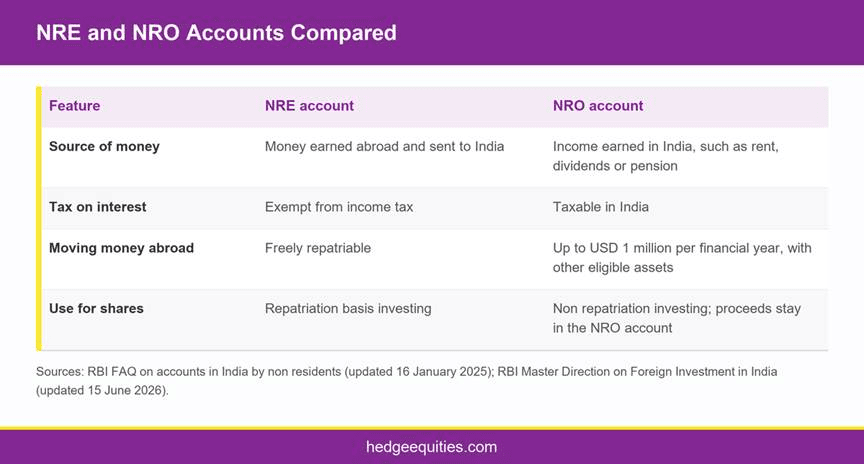
[Alt: Comparison of NRE and NRO accounts for NRI investment in Indian shares from the Gulf and Kerala] | File: infographic-1-nre-vs-nro-account.png
NRE and NRO accounts compared on tax, repatriation and use for shares
As a simple rule, money you earn in the Gulf goes through the NRE account, and money you earn in India stays in the NRO account. Many families hold both.
Remember that shares in India are bought and sold in rupees. When you eventually move money back to the Gulf, changes in the rupee against the dirham, riyal or dinar will affect what you receive. For long term NRI investment in Indian shares this matters less, but it is worth keeping in mind if you may need the money abroad within a few years.
Questions Gulf NRIs Often Ask
Can NRIs invest in Indian shares?
Yes. NRIs can buy listed Indian shares on a repatriation or a non repatriation basis, using a demat and trading account linked to the matching bank account. They cannot simply use a resident account after moving abroad. Hedge Equities advisors help NRI clients set up accounts that fit their plans, whether they expect to return to Kerala or settle abroad for good.
Can NRIs invest in PMS in India?
A PMS has a SEBI minimum investment of ₹50 lakh, and the shares are held in the investor's own name. Whether a particular manager accepts NRI clients, and through which account, varies, so always confirm before applying. Hedge Equities offers Equity, Hybrid and Debt PMS schemes, and our advisors can explain whether a PMS suits your account type and goals.
How much can an NRI invest in one Indian company?
Under the RBI's directions updated in June 2026, a single NRI's holding in a listed company must stay below 10% of its paid up capital, and all individual non residents together cannot exceed 24%. These limits matter mostly for large holders and promoter families, not for typical portfolios. Hedge Equities advisors keep these rules in view when building concentrated portfolios for business families.
Repatriation and Non Repatriation Investing
When you buy shares, you choose whether the money can later go back abroad. This choice is easy to overlook, but it decides where the sale proceeds land and how freely you can move them.
The RBI Master Direction on foreign investment allows NRIs to buy listed shares on a repatriation basis using money remitted from abroad or held in a repatriable account. Under the non repatriation route, shares can be paid for from NRE, FCNR or NRO accounts, but the sale proceeds are credited only to your NRO account.
If you plan to return to Kerala, the non repatriation route may be enough. If your future is abroad, a repatriation route keeps your options open. Either way, NRI investment in Indian shares should follow a clear plan rather than habit.
Many Gulf families hold a mix: a repatriable portfolio for goals abroad, such as children studying overseas, and a non repatriable portfolio for a future home or retirement in Kerala. Splitting money by goal like this keeps each portfolio simple and avoids awkward transfers later.
Not sure which route suits your family? Talk to our advisors before you place your first order.
Tax, Paperwork and Getting Started
Tax and paperwork are where most NRIs get stuck. A little preparation makes NRI investment in Indian shares far smoother, both when you invest and when you sell.
When an NRI sells shares, the buyer or broker deducts tax at source, as the income tax department's Form 15CA FAQ explains for payments to non residents. Keep every contract note and tax certificate, because you may need them to claim credit, file a return in India or move money abroad.
Update your KYC with your current overseas address and phone number, and keep your PAN linked to your accounts. Small gaps in paperwork are the most common reason NRI investment in Indian shares gets held up at the bank or broker. A yearly check of your documents avoids most of these delays.