
Every pms service provider in India can produce a glossy presentation. Far fewer will hand you their Disclosure Document unprompted, and fewer still will explain their fee structure in plain language before you ask twice. This guide gives you the checks that actually separate a credible portfolio manager from a well-marketed one: registration, disclosure, fee structure, reporting, and the red flags that should end a conversation early.
None of these checks require legal training or specialist knowledge. They require patience, a willingness to ask direct questions, and a refusal to sign anything until you have seen it in writing. Investors who skip this process are not usually harmed by fraud, which is rare, but by mismatched expectations that surface only after a year of underwhelming reports.
Key Takeaways
Confirm SEBI registration independently rather than trusting a business card or website badge.
Read the mandatory Disclosure Document before signing anything; it is where real fee and risk terms live.
Compare fixed-fee and profit-share models against your own return expectations, not the manager's pitch.
Step One: Verify SEBI Registration Directly
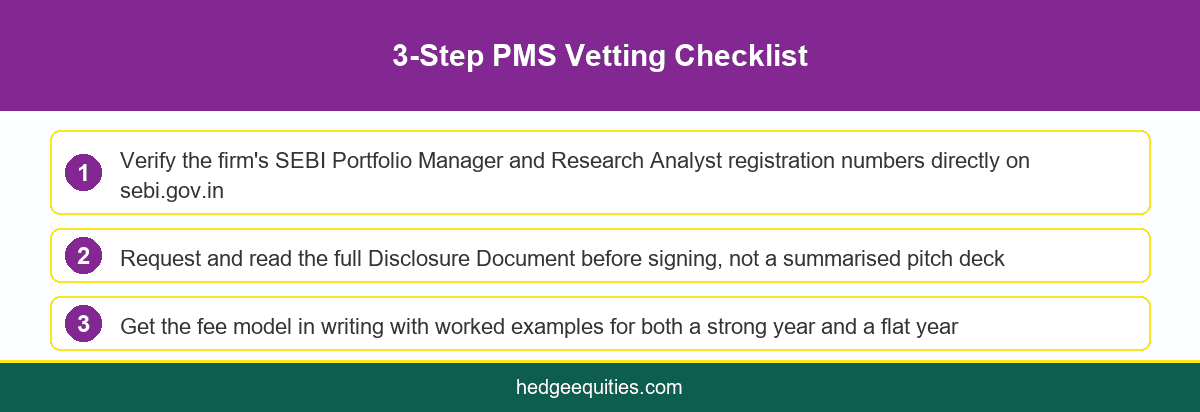
Any firm offering portfolio management services in India must hold a SEBI Portfolio Manager registration. Do not take this on trust from a brochure. Cross-check the registration number directly against SEBI's own published intermediary records at sebi.gov.in, and note that research or advisory services are registered under separate categories, Research Analyst or Investment Adviser, which are not interchangeable with a PMS licence.
Hedge Equities, for reference, holds both a PMS registration (PMS-INP000003476) and a Research Analyst registration (RA-INH000004398). Any provider you evaluate should be able to state their registration numbers as readily as their AUM figures.
It is worth checking not just that a registration exists, but how long it has been active and whether any regulatory actions are on record. SEBI's public records typically show the registration date and current status, which gives you a sense of how established the firm's PMS operations actually are, separate from how long the firm itself has existed under a different licence category.
A common confusion worth clearing up here: a firm can be a long-established, well-known name in Kerala's financial services market while its PMS registration specifically is relatively recent. Neither fact alone tells you whether the firm will manage your portfolio well, but conflating brand recognition with regulatory track record in this specific licence category is a mistake worth avoiding.
Step Two: Read the Disclosure Document, Not the Pitch Deck
SEBI requires every registered portfolio manager to publish a Disclosure Document covering the firm's investment approach, past performance presented in a prescribed format, risk factors, and all fees and charges. This document is legally required to exist and is usually available on request, sometimes on the firm's own website.
The Disclosure Document is where you find what a sales conversation tends to gloss over: how performance is calculated and against what benchmark, what happens during a drawdown, and whether the firm has faced any regulatory action. If a provider is reluctant to share this document before you sign, treat that reluctance itself as useful information.
Pay particular attention to the performance disclosure section. SEBI's prescribed format requires performance to be shown net of fees and across a standard set of time periods, which makes it possible to compare providers on a like-for-like basis rather than relying on whichever headline number a sales conversation chooses to lead with.
Read the risk factors section in full rather than skimming it. This is where a provider is required to disclose the specific risks of their stated strategy, concentration limits they actually follow internally, and any material dependence on a single fund manager or a small investment team. A thin risk factors section on an otherwise polished document is itself worth asking about directly.
Step Three: Understand the Fee Model Before You Compare Returns
PMS fee structures generally fall into three patterns: a flat annual management fee regardless of performance, a pure profit-share above a hurdle rate, or a hybrid combining a lower fixed fee with a smaller profit-share. Each rewards the manager differently, and each changes how aligned their incentives are with yours during a weak market.
A pure profit-share model with a high hurdle can look cheap in a strong year and expensive in a flat one, since the manager may still collect base costs while you see minimal net return. Ask for worked examples showing what the fee would have been in both a strong year and a flat year from the firm's own published track record, not a hypothetical.
Also ask how exit and early redemption are handled. Some PMS agreements apply an exit load if you withdraw within a minimum holding period, and some structure the profit-share calculation differently depending on whether you exit mid-year or at a formal reporting date. These details rarely appear in a first conversation and should be confirmed in writing before you commit capital.
Request a written illustration comparing the total cost of the fee structure over a five-year horizon under three scenarios: a strong-return scenario, a flat scenario, and a scenario with one significant drawdown year. Very few providers volunteer this comparison unprompted, but almost all can produce it if asked, and the exercise tends to reveal which fee structure genuinely suits your own risk tolerance and expected holding period.
Step Four: Ask About Reporting Before You Need It
A credible provider should be able to show you a sample client report before you sign anything, not describe one verbally. Look for clarity on holdings, transaction history, fee deductions, and performance versus the agreed benchmark, all in a format you can actually read without a finance background.
Ask how often reports are issued and whether ad hoc reporting is available if you need an update outside the normal cycle, for instance around a major market event or a personal financial decision. SEBI sets minimum reporting requirements, but many firms offer more frequent updates as a service differentiator, and it is reasonable to expect this at the private wealth end of the market.
It also helps to ask who you would actually speak to if you had a question about a specific transaction in your report, a dedicated relationship manager, a shared service desk, or the fund manager directly. The answer tells you a great deal about how the firm is structured to support clients day to day, beyond the quality of the report itself.
Red Flags Worth Walking Away From
Be cautious of any provider who guarantees a specific return, since SEBI rules explicitly prohibit portfolio managers from guaranteeing returns. Be equally cautious of vague answers about registration numbers, reluctance to share the Disclosure Document, or fee structures explained only verbally and never in writing. None of these are automatically disqualifying on their own, but together they are a pattern worth taking seriously.
Other patterns worth noticing: pressure to sign quickly before you have had time to review the Disclosure Document properly, an unwillingness to provide references from existing clients, or a fee structure that changes between the first conversation and the final paperwork without a clear explanation for the change.
For context on how a bespoke mandate should actually be structured once you have chosen a provider, see our guide to private portfolio management and negotiable mandate terms, and for the broader question of what kind of private wealth relationship fits your situation, start with our Pillar guide to private wealth management companies.
A Short Reference List for Your First Meeting
Walking into a first meeting with a prepared list makes the whole vetting process faster and harder to talk around. At minimum, ask for the firm's SEBI PMS registration number in writing, a copy of the current Disclosure Document, a written fee schedule covering both the base and any profit-share component, a sample client report, and two references from existing clients with a broadly similar portfolio size to yours.
Ask how long the person you are speaking with has personally been managing PMS client relationships, separate from how long the firm has existed. Advisor continuity matters more than most investors expect, particularly for a private wealth relationship that is meant to run for a decade or longer rather than a single market cycle.
Finally, ask what happens administratively if your primary relationship manager leaves the firm. A provider with a documented handover process and shared client records is better positioned to serve you through staff changes than one that relies entirely on a single individual's personal knowledge of your account. This single question often reveals more about a firm's actual operational maturity than anything in its marketing material.
None of this vetting process needs to feel adversarial. A provider that is genuinely confident in its registration, its documentation and its fee structure will typically welcome direct questions, since answering them well is itself a demonstration of competence. Treat a defensive or evasive response to any of these questions as data, not as rudeness to be politely overlooked.
Conclusion
Vetting a pms service provider is a short process if you insist on three things: an independently verified SEBI registration, a fully read Disclosure Document, and a fee model explained in writing with worked examples. Providers who welcome this scrutiny are usually the ones worth working with. Hedge Equities' Portfolio Management Services page sets out the firm's own registration details and approach for exactly this kind of evaluation.
Investments in securities market are subject to market risks. Read all the related documents carefully before investing. Hedge Equities Ltd is registered with SEBI as a Portfolio Manager (PMS-INP000003476) and a Research Analyst (RA-INH000004398). This article is for general educational purposes and does not constitute personalised investment advice.
Frequently Asked Questions
How do I check if a PMS provider is SEBI registered?
Search the firm's registration number directly on SEBI's official website rather than relying on a business card or brochure claim. Every legitimate portfolio manager holds a verifiable registration number.
What is a PMS Disclosure Document?
It is a SEBI-mandated document every portfolio manager must maintain, covering investment approach, performance history in a prescribed format, risks and fees. Request it before signing any mandate.
What fee models do PMS providers use?
Common structures are a flat management fee, a profit-share above a hurdle rate, or a hybrid of both. Ask for worked examples in both strong and flat market years before comparing providers.
Can a PMS provider guarantee returns?
No. SEBI regulations prohibit portfolio managers from guaranteeing returns to clients. Any provider doing so is not following SEBI's rules.
What is the minimum investment for PMS in India?
SEBI sets a minimum of ₹50 lakh for portfolio management services. Below that threshold, investors typically use mutual funds or other pooled products instead.
Is a Research Analyst registration the same as a PMS registration?
No. Research Analyst, Investment Adviser and Portfolio Manager are separate SEBI registration categories with different rules. Confirm which specific registration a firm holds for the service you want.
How often should a PMS provider report performance?
SEBI requires prescribed periodic reporting formats. Ask for a sample report before signing so you understand exactly what you will receive and how often.
What happens if a PMS provider underperforms its benchmark?
Fee structures and mandate terms determine this. A hybrid fee model may still charge a base fee during underperformance, which is why reviewing worked fee examples in a flat year matters before signing.
Should I choose a local Kerala PMS provider or a national firm?
It depends on whether you need in-person, local-context advice. Our guide on whether a local portfolio manager matters discusses this trade-off in more depth.
What documents should I keep after signing a PMS mandate?
Retain the signed Disclosure Document, the mandate agreement, and every periodic performance report. These are your primary reference if a dispute over fees or performance ever arises.