
Kerala has no shortage of investment companies competing for your savings, from long established wealth managers to newer entrants promising quick returns through social media. Before you hand over a rupee, there is one check that matters more than any brochure: is the firm actually SEBI registered for the service it claims to offer. This guide walks through exactly how to verify that in under fifteen minutes.
Key Takeaways
·SEBI registration is checkable in minutes directly on sebi.gov.in, and any genuine investment company will supply its registration number without hesitation.
·Investment Advisor, Research Analyst, and Portfolio Manager are separate SEBI registrations. Ask which one a firm holds before assuming it covers what they are selling.
·Complaint history against a registered entity is public and worth checking before you commit funds, not after.
This is not a theoretical exercise. Hedge Equities regularly hears from prospective clients who were approached by firms using confident, professional sounding language, complete with dashboards and projected return charts, that turned out to hold no SEBI registration at all for the activity being sold. The five checks below take roughly the same time as researching a restaurant online, and the downside of skipping them is considerably larger than a disappointing meal.
Why Verification Matters More in Kerala Right Now
Kerala's high savings rate, driven partly by Gulf remittances and partly by a culturally strong saving habit, has made the state an active market for both genuine investment companies in Kerala and, unfortunately, unregistered operators borrowing the language of legitimate finance. Names that sound like credible wealth management companies routinely appear in social media groups and WhatsApp forwards, offering guaranteed monthly returns that no SEBI registered entity is permitted to promise on a market linked product.
The practical risk is not limited to outright fraud. Even well intentioned but unregistered advisors operate without the disclosure obligations, grievance mechanisms, and audit requirements that SEBI registration imposes. Verification protects you from both categories at once, and it costs you nothing but a few minutes.
Kerala's specific vulnerability comes from three overlapping factors: a high concentration of savings relative to population, a strong culture of acting on referrals from family and community networks rather than cold outreach, and a large Gulf NRI population that cannot always attend an in-person meeting before committing funds. Together, these make a confident, well referred pitch harder to question on instinct alone, which is exactly why an external, factual check matters more here than a gut feeling about whether someone seems trustworthy.
Step One: Ask for the Registration Number Directly
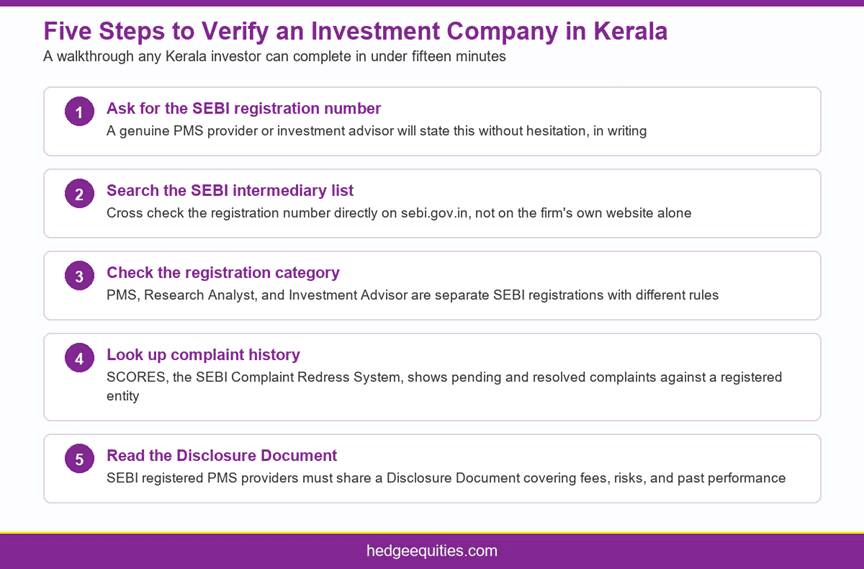
Every SEBI registered Investment Advisor, Research Analyst, and Portfolio Manager is issued a formal registration number. A genuine firm will state this in writing, typically on its website footer, disclosure documents, and client agreements, without you needing to ask twice. Hedge Equities, for example, holds PMS registration INP000003476 and Research Analyst registration INH000004398, both displayed on our disclaimer page.
Hesitation, vague answers, or a registration number that the firm cannot immediately produce is itself a warning sign worth taking seriously, regardless of how polished the rest of the sales conversation sounds.
Write the registration number down at the time it is given to you, along with the exact legal entity name, rather than relying on memory or a screenshot of a chat message that could later be edited or deleted. This small habit matters if a dispute ever arises and you need to demonstrate exactly what was represented to you at the point of investment.
Step Two: Cross Check on the SEBI Website Directly
Do not stop at taking the firm's word for it. SEBI maintains a public list of all registered intermediaries. Search the registration number the firm gave you against this list, and confirm the registered entity name matches exactly what appears on your investment documents. A mismatch, even a minor one, is worth raising directly with the firm before proceeding.
If the exact registration number is not immediately traceable in the public list, do not assume it is simply a search error on your part. Contact SEBI's own investor helpline to confirm, rather than accepting a fresh explanation from the firm about why the record might not show up as expected.
Step Three: Understand What the Registration Actually Covers
SEBI issues separate registrations for different activities. A Research Analyst registration permits publishing investment research and recommendations. An Investment Advisor registration permits personalised advice for a fee. A Portfolio Manager registration, the category portfolio management services operates under, permits discretionary or non-discretionary management of a client's individual portfolio above the Rs 50 lakh regulatory minimum.
A firm holding a Research Analyst registration but managing your money on a discretionary basis is operating outside its licensed activity, even if the underlying registration number is genuine. Confirming which specific registration covers the service being offered is as important as confirming that a registration exists at all.
This distinction also matters for fee structure. A Research Analyst is typically compensated through a subscription fee for research, while a Portfolio Manager charges a fee tied to assets managed, often with a performance component. Understanding which model applies to your relationship helps you judge whether the fee being quoted is reasonable for the category of service actually being delivered.
Step Four: Check Complaint History Before You Commit
SEBI's grievance redress system publishes complaint data against registered intermediaries, including how many complaints were filed and how they were resolved. A small number of resolved complaints is normal for any active firm serving many clients. A pattern of unresolved complaints, or complaints specifically about non-disclosure or fund misuse, deserves serious weight in your decision regardless of how the firm explains it.
This step is one investors skip most often, usually because it feels like an unnecessary formality once a recommendation has already been made by someone they trust personally. It is precisely in those personally referred situations, where scrutiny naturally relaxes, that this check matters most.
Pay particular attention to how a firm responds if you raise this check directly. A registered, well run firm will treat the question as routine and may even walk you through its own record proactively. Defensiveness or an attempt to change the subject when complaint history comes up is itself useful information about how the firm might behave if a genuine dispute arose later.
Step Five: Read the Disclosure Document Before Signing Anything
SEBI registered Portfolio Managers are required to provide a Disclosure Document covering fee structures, past performance calculated on a prescribed basis, and the risks specific to the strategies on offer. This document, not the pitch you hear verbally, is the legally binding reference point if a dispute arises later. Read it before signing, and ask direct questions about anything that is unclear rather than assuming it will be explained the same way later.
If you are still building toward the
Keep a signed or digitally acknowledged copy of the Disclosure Document for your own records after signing. If the terms of your relationship change later, whether in fee structure or investment strategy, you have a clear reference point to compare against, and a firm that later disputes what was originally disclosed has a harder time doing so against a document you retained yourself.
What This Means If You Are Choosing Between Local and Online
Verification applies identically whether the investment company in Kerala you are evaluating operates from a physical branch or purely through a digital platform. Registration status does not depend on delivery channel. What differs is how easily you can escalate a concern in person, a question we address directly in our comparison of local versus online portfolio management.
Building This Into a Habit, Not a One Time Check
Verification should not stop once you have onboarded with a firm. Registration status, key personnel, and complaint history can all change over the life of a long term investing relationship. Revisiting this five step check annually, alongside your regular portfolio review, costs little and ensures the firm managing your money today still meets the same standard it did when you first signed on.
Verifying an investment company in Kerala takes less time than most people spend comparing mobile phone plans, and the financial stakes are considerably higher. Ask for the registration number, check it directly on SEBI's records, confirm it covers the specific service being offered, review complaint history, and read the Disclosure Document before signing. Speak with a SEBI registered advisor at Hedge Equities to see our own registration details firsthand.
Frequently Asked Questions
How do I check if an investment company in Kerala is SEBI registered?
Ask for the registration number directly, then search it on sebi.gov.in to confirm the entity name and registration category match what you were told before you invest.
What is the difference between an Investment Advisor and a Portfolio Manager registration?
An Investment Advisor gives personalised advice for a fee. A Portfolio Manager, under a PMS registration, actively manages your individual portfolio above the Rs 50 lakh minimum.
Can I invest with a company that only has a Research Analyst registration?
A Research Analyst registration covers publishing research and recommendations, not discretionary portfolio management. Confirm the specific registration matches the actual service before proceeding.
What are the best financial advisors in Kerala known for?
The best financial advisors in Kerala combine verifiable SEBI registration with transparent fee disclosure and a documented process, not just years of operation or personal referrals alone.
How do I find portfolio management services near me in Kerala?
Start with SEBI verification rather than proximity alone. Our guide to
What should I do if a firm cannot show me its SEBI registration?
Treat that as a clear warning sign and do not proceed. A genuine SEBI registered firm will provide its registration number without hesitation, in writing.
Is a guaranteed monthly return from an investment company a red flag?
Yes. No SEBI registered advisor or portfolio manager can guarantee returns on market linked products, so any such promise strongly suggests the firm is operating outside SEBI's rules.
Where can I check complaints filed against a SEBI registered firm?
SEBI's investor grievance redress system publishes complaint records against registered intermediaries, which you can review before committing funds to any investment company.
Does SEBI registration guarantee good investment performance?
No. Registration confirms regulatory compliance and disclosure obligations, not investment outcomes. Past performance in the Disclosure Document should still be reviewed critically.
What should a small investor in Kerala do before choosing any advisor?
Complete a financial health checkup first, then verify the SEBI registration of any advisor before acting on their specific product recommendations.