If you have asked a portfolio manager in India about Portfolio Management Services and been told you need at least Rs 50 lakh, you are not being turned away arbitrarily. You are running into a SEBI regulation that applies to every registered portfolio manager in the country. What matters more than the rule itself is what you do next, and that is what this guide covers honestly.
This guide sits alongside our broader portfolio management services for small investors guide, and focuses specifically on the one question that guide answers only briefly: what changes, practically, the moment you learn you are below the regulatory minimum for PMS.
Too much content online either glosses over the minimum entirely or treats being below it as a temporary embarrassment to escape as fast as possible. Neither framing helps you make a good decision with the money you actually have today.
Key Takeaways
·The Rs 50 lakh PMS minimum is a SEBI regulation, not a Hedge Equities policy, and it applies to every registered portfolio manager in India.
·Mutual funds and SIPs are professionally managed portfolio management services for small investors in every practical sense, just delivered through pooled units.
·The right question is not how fast you can reach Rs 50 lakh, but whether your current investing approach is actually sound for where you are today.
What the Rs 50 Lakh Minimum Actually Is
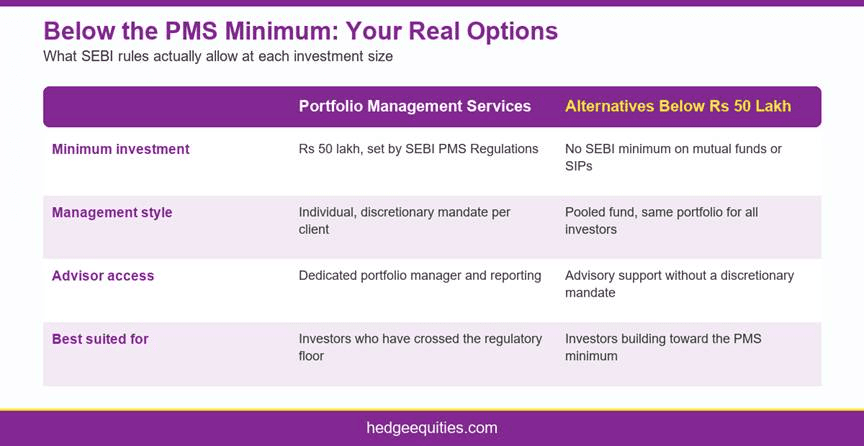
SEBI's Portfolio Managers Regulations set Rs 50 lakh as the minimum investment amount a client must commit to access discretionary or non-discretionary Portfolio Management Services in India. This is a regulatory floor that has been revised upward over time as the industry and typical portfolio sizes have grown, and it applies uniformly, regardless of which SEBI registered portfolio manager you approach.
The floor exists because PMS involves individually held securities in your own demat account, managed on a discretionary basis with regular, detailed reporting obligations. The operational cost of delivering that level of individualised service only becomes proportionate above a certain account size. It is a structural, not a punitive, threshold.
The Rs 50 lakh figure has also not stayed static. SEBI raised it from earlier, lower thresholds as the industry matured, and investors planning several years ahead should treat the number as one that historically moves upward rather than a fixed target frozen at today's value. A plan built around reaching exactly Rs 50 lakh by a specific date carries some risk of falling just short if the regulatory minimum shifts again before then.
Why the Alternatives Below the Minimum Are Not Second Best
The framing that mutual funds are what you settle for until you can afford PMS misunderstands both products. A mutual fund is professionally managed by a fund manager operating under the same broad investment discipline a PMS strategy uses, just pooling many investors into shared units rather than holding individual securities per client. For a large share of investors, even those who eventually cross the PMS minimum, a well selected mutual fund portfolio remains the better fit indefinitely.
What PMS adds is customisation. Your portfolio can exclude specific sectors or stocks for personal or religious reasons, hold concentrated positions a pooled fund cannot take on your behalf alone, and report performance calculated specifically on your account rather than a fund wide average. These are genuine benefits for the right investor, but they are not benefits every investor needs or would notice the absence of.
There is also a cost dimension worth being direct about. PMS fee structures often include a fixed management fee plus a performance component tied to returns above a benchmark. Mutual funds charge a single expense ratio, generally lower than combined PMS fees, particularly on index and passively managed funds. For a smaller corpus, this fee difference has a proportionally larger impact on net returns, which is another reason mutual funds remain genuinely competitive rather than merely acceptable while you wait.
Building a Portfolio the Right Way Below the Minimum
Start with a financial health checkup rather than a product comparison. This maps your protection cover, existing debt, and goal timelines, which determines a suitable asset allocation before any specific mutual fund or SIP amount is chosen. Product selection without this step is the most common reason small investor portfolios underperform their own reasonable expectations.
From there, a Systematic Investment Plan converts saving intent into a monthly habit that survives market volatility better than lump sum timing attempts. As the SIP corpus grows and your understanding of markets deepens, a measured allocation to direct equity and bonds can add both growth and stability, without requiring anything close to the PMS minimum.
A staged allocation approach also reduces the risk of overcommitting to a single market view. Money deployed as it becomes available, spread across several years of contributions, naturally averages into markets across both favourable and unfavourable periods, which reduces the impact of any single poorly timed lump sum decision. This is a genuine advantage of the below minimum stage that is easy to overlook while focused on reaching a threshold.
The Honest Path Toward the PMS Minimum, If You Want One
Not every investor needs a plan to reach Rs 50 lakh, and framing it as a mandatory milestone creates pressure that leads to poor decisions, such as taking on excessive risk purely to accelerate corpus growth. If reaching the PMS minimum genuinely is a goal, the most reliable route remains unglamorous: a sustained, uninterrupted SIP habit, periodic portfolio reviews, and patience through market cycles rather than attempts to time entry and exit.
Investors who eventually do cross the threshold and consider a move into private wealth management generally do so with a mutual fund and equity portfolio already well understood, which makes the transition to a discretionary PMS mandate considerably smoother than starting from a standing start at exactly Rs 50 lakh.
It is also worth separating income from invested corpus when judging where you stand. A high earner only two years into investing may have less invested than a moderate earner who started two decades earlier. Both remain firmly in the below minimum category until their actual invested assets, not their salary, cross the SEBI threshold, and advice sized off income rather than invested assets is advice built on the wrong number.
Verifying Advice at Any Corpus Size
Whether you are investing Rs 50,000 or working toward Rs 50 lakh, the advisor or platform you rely on should be SEBI registered for the specific activity they are performing. Our full walkthrough on
Being below the PMS minimum does not mean you deserve a lower standard of diligence from whoever advises you. If anything, smaller investors have less room to absorb a costly mistake, which makes verification more important, not less.
This applies equally to firms marketed as digital first alternatives promising portfolio management style outcomes below the PMS minimum through automated tools or model portfolios. Verify the specific SEBI registration such a platform holds before assuming that a modern interface implies the same regulatory oversight as a traditional advisory relationship.
A Realistic Example
Consider an investor with Rs 12 lakh saved, contributing Rs 15,000 monthly through SIPs across two diversified equity funds and one debt fund. At a reasonable long term assumption, and assuming contributions continue without interruption, this investor could plausibly approach the PMS minimum within a decade, sooner if contributions increase alongside income growth. Nothing about this path requires unusual risk taking or an accelerated product switch. It requires consistency, periodic review, and the discipline to leave the allocation alone during volatile periods rather than reacting to short term market noise.
This example is illustrative, not a projection or a promise. Actual outcomes depend on market performance, which is never guaranteed, and on the investor's own consistency, which is the one variable genuinely within their control.
The Rs 50 lakh PMS minimum is a real regulatory line, but it is not the line that determines whether you can access professional portfolio management. Mutual funds, SIPs, and SEBI registered advisory guidance are available to you today, and building that foundation properly matters more than the speed at which you eventually cross the threshold. Start with a financial health checkup to see what fits your current corpus.
Frequently Asked Questions
What is the minimum investment for Portfolio Management Services in India?
SEBI mandates a minimum of Rs 50 lakh for Portfolio Management Services. This applies to every SEBI registered portfolio manager operating in India, without exception.
Can I get professional portfolio management with less than Rs 50 lakh?
Yes. Mutual funds are professionally managed pooled portfolios available at any investment size, and SEBI registered advisors can guide fund selection without a discretionary PMS mandate.
Is a mutual fund portfolio worse than PMS?
Not necessarily. Mutual funds suit most investors well, even above Rs 50 lakh. PMS adds customisation and individual reporting, which matters for some investors but is not a universal upgrade.
How long does it take to reach the Rs 50 lakh PMS threshold?
It depends on your savings rate and market returns. A consistent SIP approach, reviewed periodically, is the most reliable path most investors use to build toward that threshold.
Should I invest in direct equity if I am below the PMS minimum?
A measured allocation to direct equity can work once you have a diversified mutual fund base and time to review individual holdings.
What should I check before choosing a mutual fund below the PMS minimum?
Review the fund manager's track record across market cycles and tenure on the specific fund, covered in
Does SEBI allow any exceptions to the Rs 50 lakh PMS minimum?
The Rs 50 lakh figure is the regulatory floor set under SEBI's Portfolio Managers Regulations and applies uniformly across registered portfolio managers in India.
What is the first step for a small investor in Kerala?
A financial health checkup first, to map protection cover, debt, and goals before selecting any specific investment product.
Is it safe to invest through an online platform below the PMS minimum?
Safety depends on SEBI registration, not delivery channel. Verify registration directly regardless of whether the platform is local or fully digital.
What happens to my mutual fund investments once I reach the PMS minimum?
You are not required to liquidate them. Many investors run a mutual fund portfolio alongside a new PMS mandate, transitioning gradually rather than switching everything at once.