
Hedge Equities was built on a simple idea: every investment, no matter how modest, serves as the starting point. Most portfolio management services conversation online assumes you already have a large sum ready to deploy. This guide is for the Kerala investor who does not, yet, and wants a straight answer on what portfolio management services for small investors actually means, what the SEBI rules allow, and what a realistic five year path looks like.
This is a long guide, deliberately, because the questions a small investor actually needs answered do not fit into a short listicle. Use the table of contents below to jump straight to the section that matches where you are today, whether that is understanding the Rs 50 lakh PMS threshold, getting a financial health checkup done for the first time, or verifying whether the advisor you are currently talking to is genuinely SEBI registered.
Key Takeaways
SEBI sets a Rs 50 lakh minimum for Portfolio Management Services. Below that, mutual funds, SIPs, and advisory guided investing are the correct tools, not lesser ones.
A financial health checkup before choosing products prevents the most common mistake small investors make: picking a product before fixing the plan.
Verifying SEBI registration takes fifteen minutes and protects you from the finfluencer and unregistered advisor problem that has grown across Kerala.
In This Guide
-> Why Small Investors Are Not a Side Business
-> Where You Actually Stand: Investing By Corpus Size
-> The Rs 50 Lakh PMS Minimum, Explained Honestly
-> Get Your Financial Foundation Right First
-> The Realistic Path From SIP to a Full Portfolio
-> Verifying Who You Trust With Your Money
-> The First Five Years: A Practical Roadmap
-> Special Considerations for Gulf NRI Investors From Kerala
Why Small Investors Are Not a Side Business
Wealth management in India has historically spoken to the investor who already has money. Kerala has a different profile: a large base of salaried professionals, small business owners, and Gulf NRI families who save consistently but rarely see products designed with them as the primary audience. portfolio management services for small investors is not a consolation category at Hedge Equities. It is the entry point into a relationship that, for many clients, eventually crosses into private wealth management for HNI investors, but only after the fundamentals are handled correctly at a smaller scale.
This matters for a practical reason. An investor who gets sold the wrong product at Rs 3 lakh often stays underinvested for years afterward, not because the market disappointed them but because the product never matched their actual situation. A mismatched product does more damage at the small investor stage than at any other, because the investor rarely has a second advisor to compare against and often concludes that investing itself did not work for them, rather than concluding that one product was a poor fit.
Three groups make up most of the small investor base Hedge Equities works with in Kerala. The first is the salaried professional in their twenties or thirties, often in Kochi, Thiruvananthapuram, or Kozhikode, with a stable monthly surplus but no structured plan for it. The second is the small business owner whose personal savings and business cash flow are not clearly separated, which complicates both goal setting and risk tolerance. The third is the Gulf NRI household sending money home for family expenses and property, with a smaller residual amount available for markets, and limited time to research products from outside India.
Each of these three profiles needs a different starting conversation, but all three share the same structural constraint: they are below the SEBI PMS minimum, and most of what gets written about portfolio management assumes they are not. This guide addresses that gap directly, without treating the below-minimum stage as a waiting room before the real advice begins.
Where You Actually Stand: Investing By Corpus Size
Before comparing products, it helps to see the four stages most investors pass through and what genuinely fits at each one. The table below is not a sales funnel. It reflects what a SEBI registered advisor actually recommends, stage by stage, including the stages where portfolio management services for small investors is not yet the right tool.
[Alt: Infographic showing what investment approach fits at each corpus size from under Rs 5 lakh to above Rs 50 lakh] | File: infographic-1-investing-by-corpus-size.png
The honest reading of this table is that most first time investors spend several years in the first two rows, and that is not a failure. It is the normal on ramp. The mistake is assuming that because portfolio management services for small investors as a discretionary PMS mandate is not yet available to you, no structured investing approach is available either.
Notice also that the boundary between rows is not a hard product switch. An investor moving from Rs 20 lakh to Rs 40 lakh does not need to abandon their mutual fund portfolio and start over. What changes gradually is the proportion allocated to direct equity, the frequency of active rebalancing, and the depth of reporting an investor should expect from whoever is advising them. Thinking of these stages as a ladder, rather than four separate products, avoids the common error of switching advisors or platforms every time the corpus crosses an arbitrary round number.
A second honest point: crossing the Rs 50 lakh threshold does not automatically mean PMS is the right choice. Some investors with Rs 60 to 80 lakh corpora are better served staying in a well constructed mutual fund portfolio, particularly if they value simplicity in tax reporting or do not need the individually held securities that PMS provides. The threshold is a regulatory eligibility line, not an automatic recommendation.
It is also worth separating corpus size from income. A high earning professional with a large monthly surplus but only two years of investing history may have a smaller corpus than a long time investor with a modest salary who started twenty years earlier. Both belong firmly in the portfolio management services for small investors category until their invested corpus, not their income, crosses the PMS floor. Advisors who size recommendations off income rather than actual invested assets are giving advice built on the wrong number.
The Rs 50 Lakh PMS Minimum, Explained Honestly
Portfolio Management Services in India operate under a minimum investment threshold of Rs 50 lakh, mandated by SEBI's Portfolio Managers Regulations. This is not a Hedge Equities policy choice. It is a regulatory floor that applies to every SEBI registered portfolio manager in the country.
Why SEBI Set a Floor
A discretionary PMS mandate means the portfolio manager buys and sells on your behalf without seeking approval for each trade. That level of discretion, combined with individually held securities rather than pooled units, carries operational and reporting overheads that only make economic sense above a certain size. The Rs 50 lakh floor exists to keep that overhead proportionate, not to gatekeep wealth management from smaller investors.
What It Does Not Mean
The floor does not mean smaller investors are locked out of professional guidance. Mutual funds are, structurally, professionally managed portfolio management services for small investors, just delivered through pooled units rather than a segregated account. Advisory relationships, where a SEBI registered advisor recommends and you execute, are also fully available below Rs 50 lakh. What changes above the floor is the delivery mechanism, not the presence or absence of professional management.
It also does not mean the Rs 50 lakh figure is fixed forever in real terms. SEBI has revised the PMS minimum upward over the years as markets and average portfolio sizes have grown, and investors planning a multi year path toward PMS should treat the figure as a moving target that historically moves up, not down. Planning to reach exactly Rs 50 lakh by a target date carries some risk of falling short if the regulatory minimum is revised again in the meantime.
Get Your Financial Foundation Right First
Before selecting any product, a financial health checkup answers three questions that most product comparisons skip entirely: how much protection cover you already carry, how much high cost debt is sitting against your goals, and what your actual time horizon is for each goal you are saving toward.
Sequencing matters more than product selection at this stage. An investor who buys an equity heavy portfolio while carrying unprotected life insurance gaps is taking on two risks at once. The protection first approach, covered in detail in our guide to insurance and investment, applies just as directly to a small investor building a first portfolio as it does to a larger one.
In practice, a financial health checkup for a small investor typically surfaces one of three gaps. The most common is inadequate term life cover relative to income and dependents, often because the investor bought a smaller policy years ago and never revisited it as income grew. The second is high cost personal loan or credit card debt sitting alongside new investment contributions, which almost always means the debt should be cleared first since its cost typically exceeds realistic post-tax investment returns. The third is a goal timeline mismatch, where money meant for a three year goal is sitting in equity mutual funds exposed to short term volatility it cannot afford to absorb.
Fixing these three gaps costs nothing beyond the checkup itself and typically takes less than an hour of an advisor's time to identify. Skipping this step to move faster into products is the single most reversible mistake a small investor makes, and also the most common one.
The Realistic Path From SIP to a Full Portfolio
For most investors below the PMS minimum, the path runs through mutual funds accessed via Systematic Investment Plans, then gradually toward a mix that includes direct equity as both capital and market understanding grow.
This is a slower path than most product marketing suggests, and that is by design. A portfolio built gradually, with allocation reviewed at each stage rather than fixed at the outset, tends to survive market cycles better than one assembled all at once based on a single point in time recommendation. Markets that look attractive when an investor first has Rs 2 lakh to deploy may look very different eighteen months later when the next Rs 2 lakh becomes available, and a staged approach absorbs that difference naturally.
Systematic Investment Plans
A Systematic Investment Plan converts irregular saving intentions into a disciplined monthly habit. For a first time investor, the SIP amount matters less than its sustainability. A Rs 5,000 monthly SIP maintained without interruption for ten years will, in almost every scenario, outperform a larger SIP that gets paused twice during market corrections.
When Direct Equity Makes Sense
Direct equity investing, through our equity investment services, becomes reasonable once an investor has built a diversified mutual fund base, has the time to review individual holdings, and can tolerate the higher single stock volatility that comes with concentrated positions. Rushing into direct equity before that foundation exists is one of the more common ways small investors take on risk they did not intend to take.
A reasonable rule of thumb, though not a regulatory one, is to keep direct equity below a third of total invested assets until the total portfolio approaches the PMS minimum. Below that level, a single poor stock selection can meaningfully dent overall returns in a way that a diversified mutual fund position cannot. Bonds, accessed through fixed income investment options, can also play a stabilising role for investors who want reduced volatility without moving entirely out of markets.
Verifying Who You Trust With Your Money
Small investors are, unfortunately, the most frequent target of unregistered investment advice in Kerala, precisely because they are least likely to already have a relationship with a SEBI registered firm and most likely to act on a confident recommendation from social media or a personal contact. The financial cost of following bad advice at a small corpus may look modest in absolute terms, but the trust cost, the years an investor stays away from markets afterward, is often much larger.
Kerala has seen a rise in unregistered advisors and social media finfluencers offering investment guidance without SEBI registration. Before acting on any recommendation, confirm the person or firm holds a valid SEBI registration. Our detailed walkthrough on verifying investment companies in Kerala covers exactly how to check this in under fifteen minutes, and the same verification applies whether the advisor operates locally or purely online.
Whether that advisor should be local to Kerala or reachable only through an app is itself a real question, one we answer honestly in our comparison of local versus remote portfolio management.
Two categories of harm show up repeatedly in complaints Hedge Equities has seen referenced through SEBI's own grievance channels. The first is guaranteed return promises, which no genuinely registered advisor or portfolio manager is permitted to make for market linked products. The second is pressure to invest through an unregistered intermediary's personal bank account rather than the regulated channel a SEBI registered entity is required to use. Either signal alone is sufficient reason to walk away from an advisor relationship, regardless of how compelling the pitch sounds.
The First Five Years: A Practical Roadmap
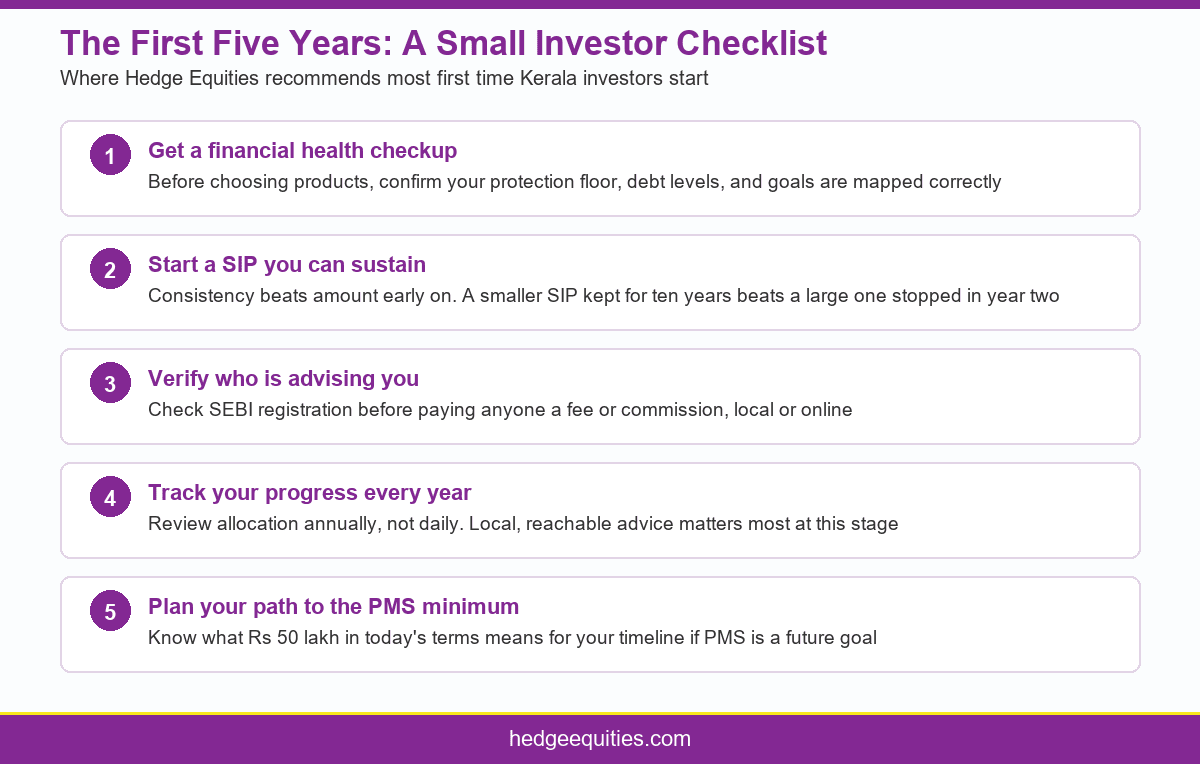
The checklist below reflects the sequence Hedge Equities recommends most first time Kerala investors follow, roughly in order, over their first five years of investing.
[Alt: Five step checklist for first time small investors in Kerala covering financial health checkup, SIPs, verification, and PMS planning] | File: infographic-2-first-five-years-checklist.png
Two clusters extend this roadmap further. If your own portfolio is concentrated in a single employer's stock through ESOPs, or your family runs a business that dominates your net worth, read concentrated holdings and single stock risk. If you are weighing whether to manage stocks yourself or hand them to a firm, direct stock portfolios versus managed portfolios walks through the real cost and time trade off.
Fund selection itself deserves ongoing attention rather than a one time decision. As your mutual fund holdings grow, the manager running each fund matters as much as the fund's past returns. Our guide on evaluating a mutual fund manager explains what to check before assuming a strong five year return will repeat under the same conditions.
None of this roadmap requires reaching the PMS minimum on any particular schedule. Some investors reach it in five years, others in fifteen, and a meaningful number never need to, because a well run mutual fund portfolio continues to serve their goals perfectly well at Rs 40 lakh or Rs 90 lakh alike. The roadmap exists to make sure the years before that point are not wasted on the wrong products, not to manufacture urgency toward a threshold that was never the actual goal.
Special Considerations for Gulf NRI Investors From Kerala
A significant share of Hedge Equities' small investor clients are Gulf based Keralites investing money earned in the UAE, Saudi Arabia, Qatar, Oman, Bahrain, or Kuwait. This group faces a specific set of constraints that generic portfolio management services for small investors content, written for a purely domestic audience, tends to ignore.
NRE Versus NRO Account Routing
Investments funded from an NRE account are typically fully repatriable, while those funded from an NRO account carry repatriation limits and different tax treatment. Choosing the wrong account to fund an investment is one of the more common and more expensive mistakes Gulf NRI investors make, since correcting it after the fact usually means unwinding and re-investing rather than a simple paperwork fix.
Tax Residency and Double Taxation
Investment income earned in India by an NRI is generally taxable in India regardless of where the investor resides, and separately, the Gulf country of residence may have its own treatment. Most Gulf cooperation council countries do not levy personal income tax, which simplifies this for many Kerala NRI investors, but the Income Tax Department rules on capital gains, dividend income, and TDS for NRIs still apply fully on the India side and should be factored into return expectations rather than treated as a detail to resolve later.
Time Zone and Remote Verification
A Gulf NRI investor working standard Gulf business hours has a narrow overlap window with Indian market hours and Indian office hours alike. This makes the SEBI verification habit described later in this guide even more important, since a Gulf based investor has less practical opportunity to visit an office in person before committing funds, and must rely more heavily on document based verification completed correctly the first time.
Hedge Equities works with Gulf NRI clients across all three of these areas as part of the same financial health checkup used for resident investors, adapted to account for repatriation status, account type, and the practical reality of managing an India based portfolio from outside the country.
Portfolio management services for small investors is not a smaller version of PMS. It is a distinct, well built path that most successful investors pass through before they ever reach the PMS minimum, if they reach it at all. Start with a financial health checkup, keep your SIP consistent, verify every advisor before you trust them, and let your corpus grow into the next stage rather than forcing it there early. Book a financial health checkup with Hedge Equities to see exactly where you stand today.
Frequently Asked Questions
What is the minimum amount for portfolio management services in India?
SEBI mandates a minimum of Rs 50 lakh for Portfolio Management Services. Below that, mutual funds and SIPs remain the SEBI compliant route to professional portfolio management for small investors.
Can a small investor get professional portfolio management below Rs 50 lakh?
Yes. Mutual funds are professionally managed pooled portfolios available at any investment size, and SEBI registered advisors can guide fund selection without requiring a discretionary PMS mandate.
How do I start investing with a small amount in Kerala?
Begin with a financial health checkup to fix your allocation, then start a Systematic Investment Plan sized to what you can sustain monthly, not the maximum you can afford this month.
Is a local Kerala advisor better than an online investment platform?
It depends on your situation. Our local versus remote comparison covers where physical presence genuinely helps, such as estate matters and Gulf NRI repatriation.
How do I verify if an investment company in Kerala is SEBI registered?
Ask for the registration number directly and cross check it on sebi.gov.in. Our full walkthrough at investment companies in Kerala covers all five verification steps.
What should I do before choosing an investment product?
Get a financial health checkup first. It maps your protection cover, existing debt, and goal timelines, which determines which products actually fit before you compare returns.
How much should my first SIP be?
Start with an amount you can sustain without interruption for at least five years. A smaller, consistent SIP outperforms a larger one that gets paused during market corrections.
When should I consider direct equity instead of mutual funds?
Once you have a diversified mutual fund base and the time to actively review individual holdings, direct equity through our equity services becomes a reasonable addition.
Does portfolio management services for small investors include insurance planning?
Protection should come before portfolio construction. See insurance and investment for how Hedge Equities sequences the two.
How long does it take to reach the PMS minimum from a small starting corpus?
It depends entirely on your savings rate and returns, but a disciplined SIP approach combined with periodic reviews is the most reliable path most Kerala investors follow toward that threshold.